🏕 20 Foot Camper Weight Calculator
Find your camper's dry weight, GVWR, payload capacity & towing requirements — imperial & metric
Dry Wt (lbs)
Dry Wt (lbs)
Dry Wt (lbs)
Dry Wt (lbs)
Dry Wt (lbs)
Dry Wt (lbs)
Dry Wt (lbs)
Dry Wt (lbs)
| Camper Type | Dry Weight (lbs) | GVWR (lbs) | Payload (lbs) | Dry Wt (kg) | GVWR (kg) |
|---|---|---|---|---|---|
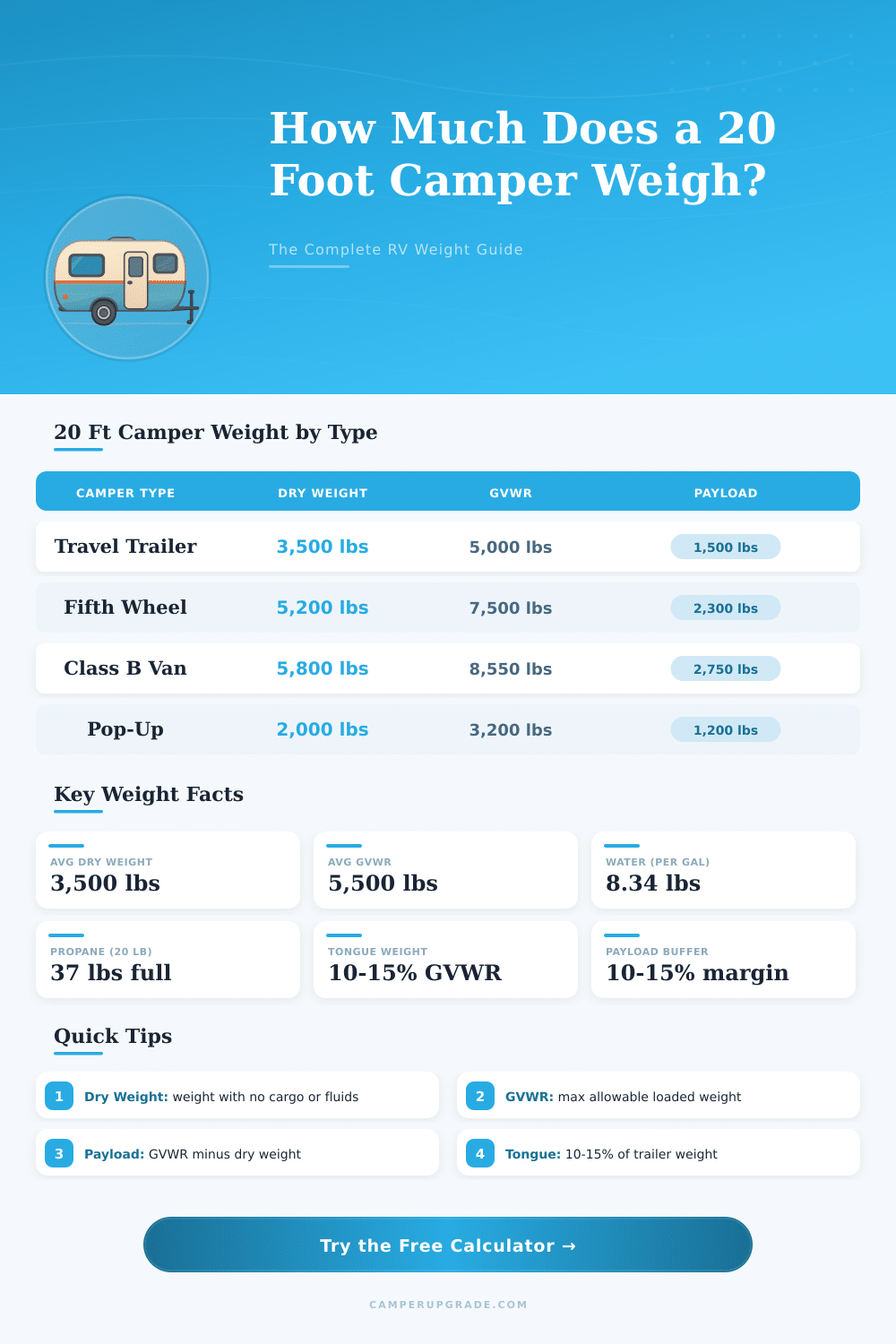
| Travel Trailer | 3,200 – 4,000 | 4,500 – 6,000 | 1,000 – 2,500 | 1,451 – 1,814 | 2,041 – 2,722 |
| Fifth Wheel | 4,800 – 5,800 | 7,000 – 9,000 | 1,500 – 3,500 | 2,177 – 2,631 | 3,175 – 4,082 |
| Class B Van | 5,200 – 6,400 | 7,500 – 9,500 | 2,000 – 3,500 | 2,359 – 2,903 | 3,402 – 4,309 |
| Class C | 4,800 – 6,500 | 8,000 – 11,000 | 2,000 – 5,000 | 2,177 – 2,948 | 3,629 – 4,990 |
| Pop-Up Camper | 1,500 – 2,500 | 2,500 – 3,800 | 800 – 1,500 | 680 – 1,134 | 1,134 – 1,724 |
| Toy Hauler | 4,200 – 5,500 | 6,000 – 8,500 | 1,500 – 3,500 | 1,905 – 2,495 | 2,722 – 3,856 |
| Teardrop | 1,500 – 2,200 | 2,200 – 3,500 | 600 – 1,400 | 680 – 998 | 998 – 1,588 |
| Hybrid Trailer | 2,800 – 3,600 | 4,000 – 5,500 | 1,000 – 2,000 | 1,270 – 1,633 | 1,814 – 2,495 |
| Truck Camper | 1,200 – 2,000 | 1,800 – 3,000 | 500 – 1,200 | 544 – 907 | 816 – 1,361 |
| Add-On Item | Weight (lbs) | Weight (kg) | Notes |
|---|---|---|---|
| Fresh Water (full tank) | 8.34 per gallon | 3.78 per liter | 40 gal tank = 334 lbs |
| Gray/Black Water (full) | 8.34 per gallon | 3.78 per liter | Counts toward GVWR |
| 20 lb Propane Tank (full) | 37 lbs | 16.8 kg | Tank + fuel weight |
| 30 lb Propane Tank (full) | 54 lbs | 24.5 kg | Tank + fuel weight |
| 40 lb Propane Tank (full) | 70 lbs | 31.8 kg | Tank + fuel weight |
| Slide-Out (single) | 800 – 1,200 | 363 – 544 | Adds significant mass |
| Generator (portable) | 100 – 250 | 45 – 113 | Plus fuel weight |
| Solar Panels (roof) | 40 – 80 | 18 – 36 | Per 200W panel setup |
| Average Person | 150 lbs | 68 kg | Used as estimate |
| Typical Cargo/Gear | 400 – 800 | 181 – 363 | Clothes, food, supplies |
| Loaded Weight (lbs) | Min Tow Rating Needed | Tongue Weight (10-15%) | Typical Tow Vehicle |
|---|---|---|---|
| Up to 2,000 | 2,500 lbs | 200 – 300 lbs | Midsize SUV |
| 2,000 – 3,500 | 4,000 lbs | 300 – 525 lbs | Full-size SUV |
| 3,500 – 5,000 | 6,000 lbs | 525 – 750 lbs | 1/2-ton Pickup |
| 5,000 – 7,500 | 8,500 lbs | 750 – 1,125 lbs | Heavy 1/2-ton or 3/4-ton |
| 7,500 – 10,000 | 11,000 lbs | 1,125 – 1,500 lbs | 3/4-ton or 1-ton Pickup |
| 10,000+ | 13,000+ lbs | 1,500+ lbs | Heavy-duty 1-ton |
The weight of a camper seems easy, until you genuinely start to research it, then everything becomes difficult very soon. Travel trailers range from around 1 000 pounds for the most small to 8 500 pounds and where your weight sits depends on the length, total heavy load and what it carries when fully loaded. Pop-up campers stand on the more lightweight part, usually between 600 pounds and a bit above a ton.
For more small pop-up models the weight can be between 1 500 and 7 000 pounds, what ultimately depends on how much heavy load your tow vehicle can bear.
How Much Do Campers Weigh?
Dry weight is the simple part, it is simply the camper itself without anything inside it. No fuel, no water, no gear, no people. Those numbers range a bit according to the materials used to build it, the methods of building, what comforts are included and how roomy the interior.
Bigger size naturally must mean more mass. From my expreience, around 1 500 pounds is a good guess if you choose your first trailer.
Wet weight enters the game, and that is an entirely other matter. It happens when all tanks fill. Fresh water, dirty water, all gear.
That is your weight in the worst situation. You can add around 1 000 pounds to the dry weight to have a more real idea about what you indeed have. Some people add almost 1 500 pounds when you consider gear and water together, although that depends on the length of the camper and how it was built.
Average fifth wheel weight is somewhere around 12 700 pounds when they are unloaded. Most recreational vehicles fall in the range of 10 000 to 13 000 pounds according to their length and the set of options that you choose. The big ones with slide-out sections and those fancy living rooms?
They reach 15 000 pounds easily. Toy haulers weigh even more… Their gross vehicle heavy limits go from only 15 000 to above 22 000 pounds.
The biggest motorhome vehicles stretch to 45 feet and can pass 50 000 pounds.
Do not forget the tongue weight either. It is the mass that sits directly on your hitch. Campers with one axle commonly have quite big tongue weights, especially when you add batteries, bike racks or other gear.
What the factory specs say and what genuinely happens in real life can differ a lot.
Gross vehicle heavy limits are you’re strict bars… The highest tow weight that the maker says to not pass. You find that information in the owner manual, online in specs or printed directly on the trailer.
To check specs of your tow vehicle, look at the label fixed in the driver door frame. It shows your gross vehicle weight, gross axle weight and curb weight. Curb weight is only the unloaded vehicle with basic liquids and full tank.
Factory dry weights are not always right, so you should trust the grossvehicle weight when you estimate tow ability. Stay inside those limits so that everything works safely.