⚡ RV Electricity Usage Calculator
Estimate how much electricity your RV uses per month — enter your appliances and daily usage hours
| ✔ On? | Appliance | Watts (W) | Hours/Day | kWh/Month |
|---|
| Appliance | Watts | Avg Hrs/Day | kWh/Day | kWh/Month |
|---|---|---|---|---|
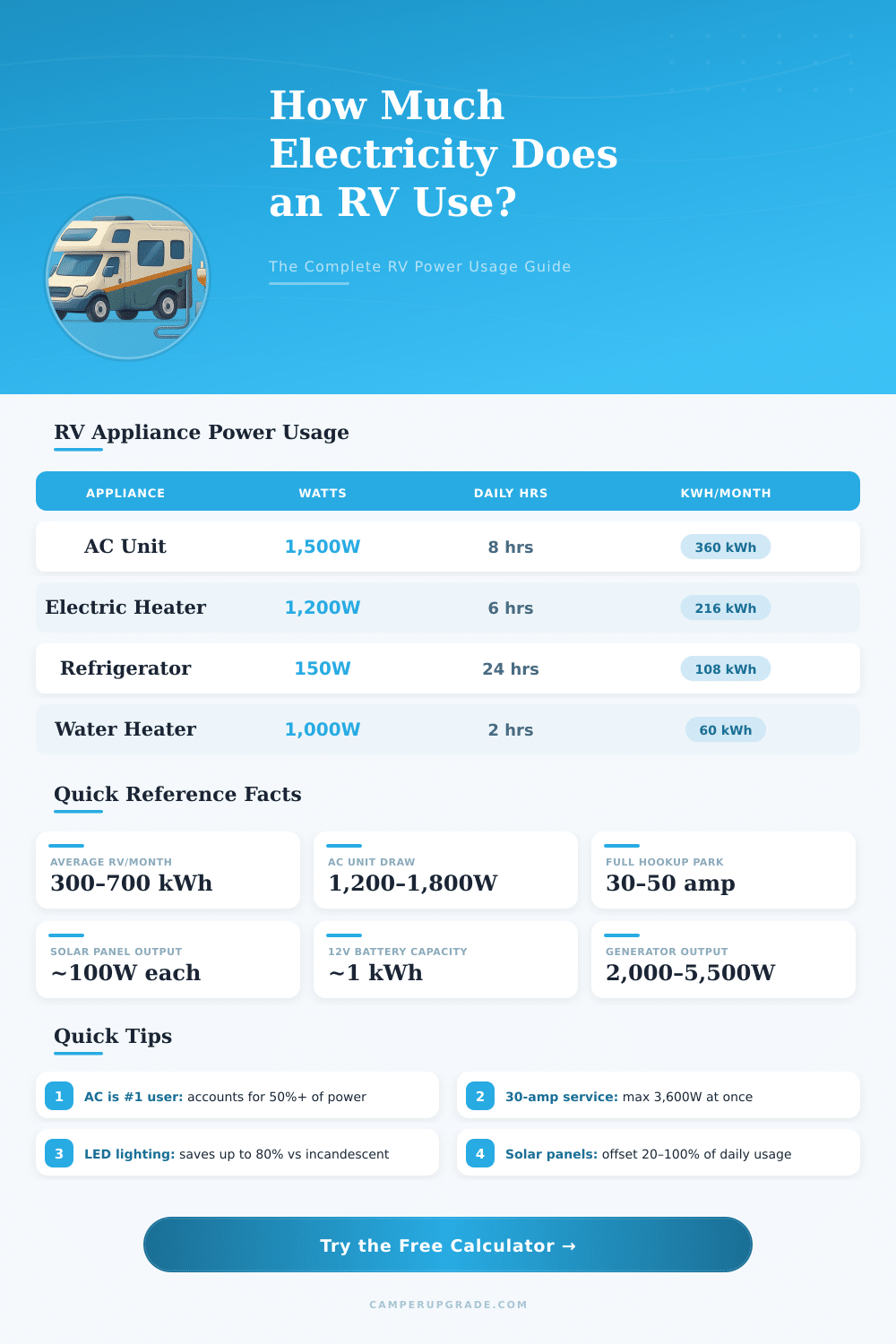
| Air Conditioner (13,500 BTU) | 1,500 W | 8 | 12.0 | 360 |
| Air Conditioner (15,000 BTU) | 1,800 W | 8 | 14.4 | 432 |
| Electric Space Heater | 1,200 W | 6 | 7.2 | 216 |
| Electric Water Heater | 1,000 W | 2 | 2.0 | 60 |
| Refrigerator (12V compressor) | 150 W | 24 | 3.6 | 108 |
| Refrigerator (2-way propane/elec) | 300 W | 24 | 7.2 | 216 |
| Microwave (1,100W) | 1,200 W | 0.5 | 0.6 | 18 |
| Electric Cooktop / Induction | 1,800 W | 1 | 1.8 | 54 |
| TV (32″) | 60 W | 4 | 0.24 | 7.2 |
| Laptop Computer | 45 W | 6 | 0.27 | 8.1 |
| Smartphone Charging | 10 W | 8 | 0.08 | 2.4 |
| LED Interior Lighting (total) | 50 W | 5 | 0.25 | 7.5 |
| Ceiling Fan | 35 W | 8 | 0.28 | 8.4 |
| CPAP Machine | 30 W | 8 | 0.24 | 7.2 |
| Washing Machine (portable) | 500 W | 0.5 | 0.25 | 7.5 |
| RV Type | Usage Scenario | Avg kWh/Month | Amps (30A svc) |
|---|---|---|---|
| Class A Motorhome | Full hookups, summer | 400 – 700 | 30–50A |
| Class B / Camper Van | Mixed hookups / solar | 60 – 150 | 15–20A |
| Class C Motorhome | Full hookups | 250 – 500 | 25–40A |
| Travel Trailer (30’+) | Full hookups | 200 – 450 | 20–35A |
| Fifth Wheel | Full hookups, full-time | 350 – 650 | 30–50A |
| Pop-Up / Tent Trailer | Campground hookup | 30 – 80 | 10–15A |
| Any RV (boondocking) | Solar + battery only | 15 – 60 | N/A |
| Service Type | Max Amps | Max Watts | Best For |
|---|---|---|---|
| 15A Standard Outlet | 15A | 1,800W | Small trailers, vans |
| 20A Outlet | 20A | 2,400W | Small trailers |
| 30A RV Hookup | 30A | 3,600W | Most travel trailers, Class C |
| 50A RV Hookup | 50A | 12,000W | Class A, fifth wheels, dual AC |
| Generator (2,000W) | ~16A | 2,000W | Boondocking basics |
| Generator (3,500W) | ~29A | 3,500W | Single AC unit + essentials |
| Generator (5,500W) | ~45A | 5,500W | Dual AC, full-time off-grid |
The typical use of electricity in rv are around 20 kWh daily, like the use in many homes. That amount changes a lot based on the model of the rv, its size, the installed devices and the way the owners use them. During a month that results roughly in 608 kWh or around 7 300 kWh yearly.
The use rises in rough weather, warm or cold, and drops in mild periods.
RV Electricity Use, Costs and How to Save
Air conditioners are one of the main drains of energy. Without the air conditioner, the day uses only 5 to 8 kWh. When it runs, the use jumps to 12 to 15 kWh a day.
Only the air conditioner itself can use 400 to 500 kWh in one month. The big AC units pull around 1 500 watts. The insulation of rv are not good, and the air condtiioners themselves do not work well, which worsens the situation.
Besides that, other devices add to the amount. A typical water heater in an rv uses around 1 200 watts. The refrigerator, when it works on electricity, pulls about 600 watts.
Space heaters are another heavy drain, with most using 1 300 to 1 700 watts. Electric heaters commonly take almost three times more than other usual devices. In most rv, the three main energy users are the air conditioner, the refrigerator and the microwave.
A 30-amp connection in an rv allows you to work with around 3 600 watts. When the rv does not need more then 2 100 maximum watts, one can safely plug it in a normal 20-amp outlet. A 50-amp system can handle even up to 12 000 watts.
The prices for electricity in rv parks range a lot. Typical rates are around 8 cents each kWh in areas with water energy to almost 19 cents in areas with fuel sources of high cost. Most fall between 13 and 16 cents.
Some parks charge even 30 cents each kWh. For short trips, the electricity usually is part of the overnight payment. For longer stays or permanent residents, one gets a separate meter for the energy.
Monthly bills can go from around 33 dollars to more than 200 dollars, based on the use and the place. For instance, one person in a warm area paid roughly 170 dollars monthly because of heavy use of AC at 27 cents each kWh.
There are ways to reduce the energy. Solar panels can help, and some rv already have them installed. Even so, most rv need to connect to an outside source for heavy devices like microwaves and air conditioners.
Simple savings work well, for instance heat water on a propane stove instead of using an electric coffee maker, choose LED lights rather than old ones and limit the use of electronics. Using a propane water heater instead ofelectrical is another good option for folks in rural areas.