⛽ RV Fuel Tank Calculator
Estimate your RV's fuel range, tank capacity, and fuel stop planning by RV type
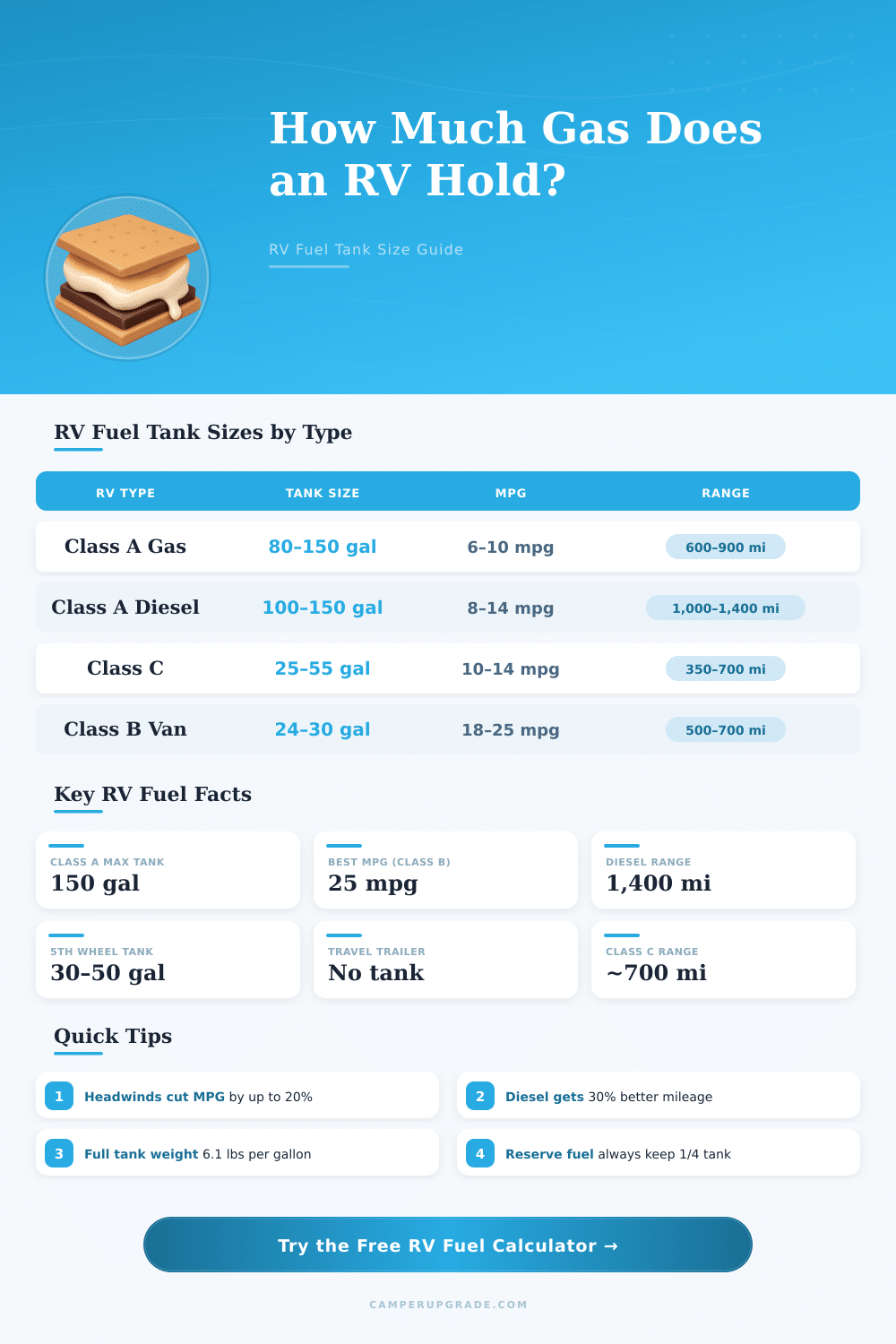
| RV Type | Typical MPG | Tank Size | Max Range |
|---|---|---|---|
| Class A Gas | 6–10 mpg | 80–150 gal | 600–900 mi |
| Class A Diesel | 8–14 mpg | 100–150 gal | 800–1,400 mi |
| Class C Motorhome | 10–14 mpg | 25–55 gal | 350–700 mi |
| Class B Camper Van | 18–25 mpg | 24–30 gal | 450–700 mi |
| 5th Wheel (Truck) | 8–14 mpg | 26–38 gal | 250–500 mi |
| Travel Trailer (Truck) | 8–14 mpg | 26–38 gal | 250–500 mi |
| Toy Hauler (Truck) | 7–12 mpg | 26–38 gal | 200–450 mi |
| Micro / Teardrop | 20–30 mpg | 12–20 gal | 300–550 mi |
| Gallons (US) | Liters | Weight (Gas, lbs) | Weight (Diesel, lbs) |
|---|---|---|---|
| 10 gal | 37.9 L | 61 lbs | 71 lbs |
| 25 gal | 94.6 L | 152.5 lbs | 177.5 lbs |
| 50 gal | 189.3 L | 305 lbs | 355 lbs |
| 80 gal | 302.8 L | 488 lbs | 568 lbs |
| 100 gal | 378.5 L | 610 lbs | 710 lbs |
| 120 gal | 454.2 L | 732 lbs | 852 lbs |
| 150 gal | 567.8 L | 915 lbs | 1,065 lbs |
| Tank Size | 6 MPG | 10 MPG | 14 MPG | 22 MPG |
|---|---|---|---|---|
| 25 gal | 150 mi | 250 mi | 350 mi | 550 mi |
| 40 gal | 240 mi | 400 mi | 560 mi | 880 mi |
| 80 gal | 480 mi | 800 mi | 1,120 mi | — |
| 100 gal | 600 mi | 1,000 mi | 1,400 mi | — |
| 150 gal | 900 mi | 1,500 mi | 2,100 mi | — |
These bits from real stories and live experiences, that folks actually living in RV share with us.
Sizes of Gas tanks change a lot according to the kind of vehicle that you use. Class A motorhomes have the biggest, talk about 80 to 150 gallons. Models of Class C normally have between 40 and 80 gallons.
RV Gas and Propane Basics
Class B stays the small option, with tanks that usually store around 25 gallons. Naturally, the tank that you get depends fully on the class of your RV.
Filling a Class B motorhome costs around 93 dollars, which shows how bad expenses for Gas are. The most many owners of RV that I heard point around 5 to 7 miles each gallon. Some reach a bit more well, close to 7 or 8 mpg.
One of them said that he reached almost 6 mpg in a model of 1979, and at 5 dollars each gallon, that hurt.
To estimate your real use of Gas, it is really easy. Drive 504 miles with one 28-gallon tank? Divide 504 by 28, and you find 18 mpg.
Apps for Gas prices help to find cheaper stations near you. Besides that, discounts appear everywhere (some discounts ten cents each gallon), while others give points that build savigns.
Propane is a whole other case. No gallons, but pounds measure it for RV. A tank of 30 pounds really carries 7 gallons of propane and weighs 55 pounds full.
Here is why: propane is quite lightweight, only 4.2 pounds each gallon. Most RV owners carry either two 20-pound tanks or two of 30 pounds. The main benefit?
Propane works, whether you stay in a campground ore away from cities.
Some owners swap tanks at special stations, while others go to suppliers of propane or stores like Tractor Supply for refill. Here is the key point: if your tank of propane is firmly attached to the RV, you will have to drive with the whole vehicle… Or drag it, to get filled.
Old Gas that sits unused causes problems during trips. One owner left his RV standing for five to six years and did not want to work with cleaning of old Gas. Engines with fuel injection last through long storage more well, because the system is sealed against air, less drying, less damage.
Adding stabilizer for Gas in the tank helps it stay fresh during storage. Some owners even cover tanks during breaks, especially in season of forest fires, when one maybe needs a fast escape.
Removing a tank brings its own troubles. The unit for sending level of Gas has different patterns for bolts and specs for resistance, and it must match with the ratings of your RV exactly. Older RV commonly had odd setups.
One owner owned a model of 1974 with a helper tank of 30 gallons besides a main tank of 40 gallons. Another traveled with a Dodge of 1978 with only afactory tank of 36 gallons. Frames of Ford E350 had various sizes also, 35, 40 or even 55 gallons according to the year.