⚡ 5000 Watt Generator Gas Usage Calculator
Calculate exactly how much fuel your 5000W generator consumes per hour, per day, or per tank
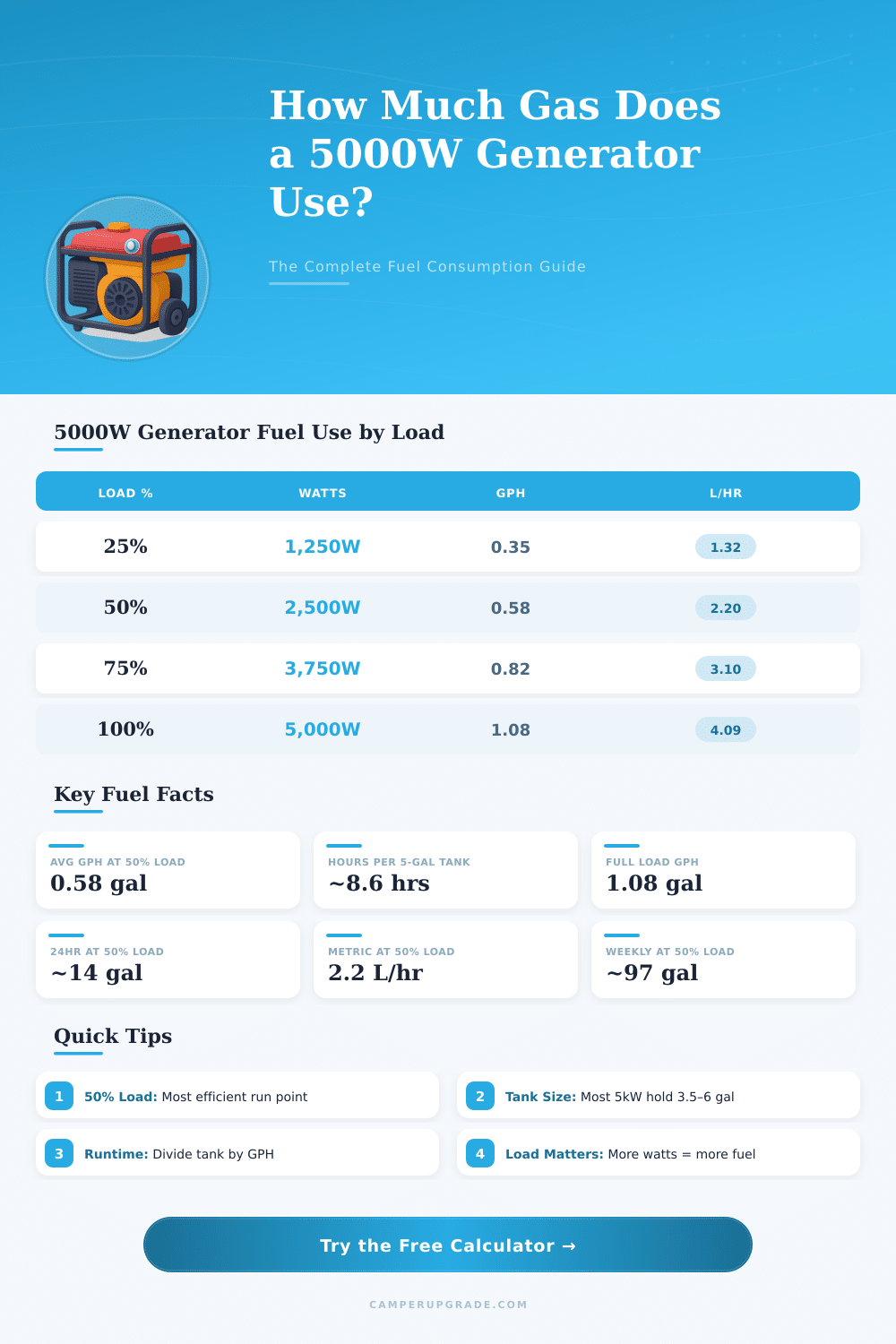
| Load % | Watts | GPH (Gasoline) | L/hr (Gasoline) | 8 Hours (gal) | 24 Hours (gal) |
|---|---|---|---|---|---|
| 25% | 1,250W | 0.35 | 1.32 | 2.80 | 8.40 |
| 50% | 2,500W | 0.58 | 2.20 | 4.64 | 13.92 |
| 60% | 3,000W | 0.68 | 2.57 | 5.44 | 16.32 |
| 75% | 3,750W | 0.82 | 3.10 | 6.56 | 19.68 |
| 90% | 4,500W | 0.97 | 3.67 | 7.76 | 23.28 |
| 100% | 5,000W | 1.08 | 4.09 | 8.64 | 25.92 |
| Fuel Type | Unit | Consumption at 50% Load | Consumption at 100% Load | Notes |
|---|---|---|---|---|
| Gasoline | Gallons | 0.58 gal/hr | 1.08 gal/hr | Most common, widely available |
| Propane (LP) | Gallons | 0.76 gal/hr | 1.40 gal/hr | ~30% higher volume; longer shelf life |
| Natural Gas | Cu Ft | ~6.5 ft³/hr | ~12 ft³/hr | Continuous supply; requires hookup |
| Tank Size | 25% Load | 50% Load | 75% Load | 100% Load |
|---|---|---|---|---|
| 3.5 gal | 10.0 hrs | 6.0 hrs | 4.3 hrs | 3.2 hrs |
| 4.0 gal | 11.4 hrs | 6.9 hrs | 4.9 hrs | 3.7 hrs |
| 5.0 gal | 14.3 hrs | 8.6 hrs | 6.1 hrs | 4.6 hrs |
| 5.5 gal | 15.7 hrs | 9.5 hrs | 6.7 hrs | 5.1 hrs |
| 6.0 gal | 17.1 hrs | 10.3 hrs | 7.3 hrs | 5.6 hrs |
| 8.0 gal | 22.9 hrs | 13.8 hrs | 9.8 hrs | 7.4 hrs |
| Appliance | Running Watts | % of 5,000W | Est. GPH Added |
|---|---|---|---|
| Window AC (10,000 BTU) | 1,200W | 24% | +0.26 gal/hr |
| Refrigerator | 150W | 3% | +0.03 gal/hr |
| Electric Heater | 1,500W | 30% | +0.32 gal/hr |
| Well Pump (1/2 HP) | 1,000W | 20% | +0.22 gal/hr |
| Microwave (1,000W) | 1,000W | 20% | +0.22 gal/hr |
| LED Lighting (10 bulbs) | 100W | 2% | +0.02 gal/hr |
| TV + Devices | 300W | 6% | +0.06 gal/hr |
| Sump Pump | 800W | 16% | +0.17 gal/hr |
Note: Here articles based on real advice and practical experiences, that RV-owners and fans with alike interests shared through various forums.
Generators for RVs offer flexibility about fuel. Main options are Gas, diesel and liquid propane. The most many motor homes and ship-platforms use units with Gas engines.
Choose the Best Fuel for Your RV Generator
Even so, if you drive with a big diesel powertrain probably the Generator operates also on diesel. Also there is propane. Some RV owners choose this option, especially when they want to escape draining of the main fuel tank or drag big loads, where the space matters a lot.
In many motor homes the Generator connects directly to the main fuel tank of the car. That causes, that the run time depends fully on the amount of Gas, that stays in the tank. Here the key spot: the most many fuel systems carry a safety valve, that operates at around quarter of tank.
The Generator shuts off before the tank fully empties, what protects you against the sad situation of being stuck without fuel.
Propane gives some clear bonuses, if one chooses it. It costs less than Gas right now, does not spoil while it sits unused and does not clog the Generator like old Gas. Also the exhaust smell is more pleasant, that matters a lot in dense campgrounds, where neighbours are near.
The downside? Propane tanks need much storage space. Also, swappable tanks come three-quarters full, so you really have only around three gallons instead of the full 4,25 gallons.
Gas Generators use around half a gallon in an hour during half load. If you swich it only when you truly need it, the fuel costs stay almost unnoticed. But if it works every night for cool, and then the most of the day for lights and devices?
That uses two or three gallons daily very quickly.
Honda and Yamaha regularly show up as the most reliable brands in this field. Dual-fuel models of Champion get good marks because of their value, especially for 30-ampere travel loads, where the option of propane and Gas choices matter. Passing to propane drops the power by around twenty percent compared too pure Gas.
Add a soft start to your air conditioners helps, because the starting power spike overloads the most many Generators.
Portable power stations and solar panel systems are quieter, cleaner and lighter, also they work indoors without danger. Gas Generators on the other hand can keep your RV comfortable during whole night or whole day, if fuel is ready. Batteries however empty more quickly, when one needs from them heavy power draws like cooling orheating.
Using fuel without ethanol, you protect your Generator against engine problems from ethanol mixes. Some private campgrounds fully ban portable Generators, so it certainly pays to check before. If you keep Gas in your Generator during long times, let the engine run some seconds before you remove it…
That simple step avoids future headache.