⚡ 50 Amp RV Electricity Calculator
Calculate your total wattage, amp load, and daily kWh usage from any combination of RV appliances
| Appliance | Watts Each | Qty | Hours/Day | Total Watts |
|---|
| Feature | 50 Amp Service | 30 Amp Service | 20 Amp Household |
|---|---|---|---|
| Max Wattage | 12,000W | 3,600W | 2,400W |
| Voltage | 120V/240V (2-phase) | 120V | 120V |
| Amperage | 50A x 2 legs | 30A single | 20A single |
| Plug Type | NEMA 14-50 | NEMA TT-30 | NEMA 5-20 |
| AC Units | Up to 2-3 | 1 only | 1 (small) |
| Typical RV Size | 35 ft+ Class A/C | 20-35 ft | Pop-up / Teardrop |
| Recommended Buffer | 9,600W (80%) | 2,880W (80%) | 1,920W (80%) |
| RV Use Pattern | Avg Daily kWh | Avg Watts Running | 50A Load % |
|---|---|---|---|
| Minimal (no AC) | 3 – 6 kWh | 125 – 250W | 2 – 4% |
| Moderate (1 AC, occasional cooking) | 12 – 20 kWh | 500 – 833W | 4 – 14% |
| Heavy (2 AC, full appliances) | 25 – 40 kWh | 1,042 – 1,667W | 17 – 28% |
| Peak (all on simultaneously) | Up to 96 kWh | Up to 4,000W+ | 33 – 80% |
| Full-Time Living Average | 15 – 30 kWh | 625 – 1,250W | 10 – 21% |
| Total Watts | Amps (120V) | % of 50A Capacity | Status |
|---|---|---|---|
| 0 – 2,400W | 0 – 20A | 0 – 20% | ✅ Very Light |
| 2,401 – 4,800W | 20 – 40A | 20 – 40% | ✅ Light Load |
| 4,801 – 7,200W | 40 – 60A | 40 – 60% | ✅ Moderate |
| 7,201 – 9,600W | 60 – 80A | 60 – 80% | ⚠️ High — OK short term |
| 9,601 – 10,800W | 80 – 90A | 80 – 90% | 🔴 Over recommended limit |
| 10,801W+ | 90A+ | 90 – 100%+ | ❌ Risk of tripping breaker |
Note: This article is based on actual experiences and knowledge shared by owners of RV and managers of camping parks.
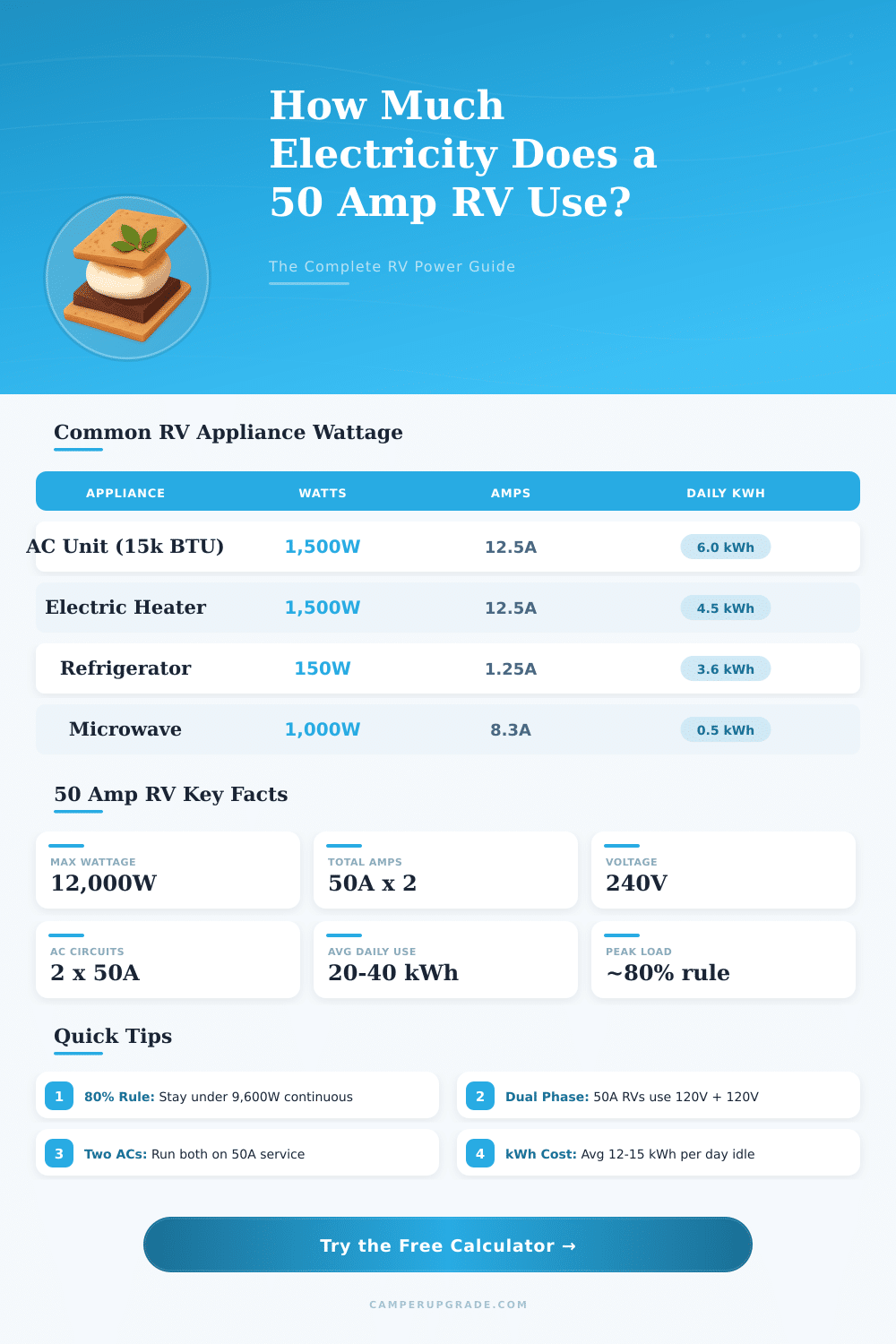
Average use of Electricity in RV reaches around 20 kWh daily. That is similar to usage in many homes. During a month that adds up to around 600 kWh, or around 7 300 kWh yearly.
How Much Electricity Do RVs Use and How to Save Energy
Even so those numbers range a lot based on the model of the vehicle, its size, installed devices and the way one uses them. Extreme temperatures, like heat or cold, can raise the usage a lot.
Without use of air conditioning, the daily cost stays between 5 and 8 kWh. If one switches the AC units on, it quickly climbs to 12 up to 15 kWh for a whole day. If both air conditioners run at the same time with a refrigerator and electric water heater, the use can raech 40 even 50 kWh daily.
Only the air conditioning itself can use 400 up to 500 kWh in one month, because the insulation of RV is not perfect and the devices themselves do not work too well.
Big units of air conditioning draw around 1 500 watts. Electric water heaters use about 1 200 watts. A refrigerator on Electricity uses around 600 watts.
Space heaters are also big energy eaters, that most commonly draw from 1 300 up to 1 700 watts. Electric heaters can spend three times more energy than typical other devices.
The usual shore power system for RV fits 30 amps at 120 volts, which delivers around 3 600 watts. That is enough to cover the heaviest devices like air conditioner, refrigerator and microwave. A system of 50 amps could handle up to 12 000 watts.
For RV whose top need does not pass 2 100 watts, a standard 20-amp outlet works grate.
The monthly costs for Electricity change a lot. Some owners pay between 35 and 75 dollars for metered energy. Others face bills of 140 up to more than 200 dollars, especially in summer because of heavy use of AC.
For instance, one owner in Texas spent around 170 dollars monthly during peak, with a rate of 27 cents each kWh. The prices in camping areas range from around 8 cents each kWh in regions with cheap water power up to 30 cents each kWh in some places. The most common rates fall between 13 and 16 cents.
Many campgrounds include the energy in the daily fee. Even so weekly or monthly stays commonly mean a separate bill for metered Electricity. Some park managers charge more for 50-amp service than for 30-amp.
RV usually need a connection to shore power to run heavy devices like a microwave or air conditioning. One can however lower the usage by means of some tricks. For instance, use propane instead of Electricity for the water heater or kitchen.
Switch to LED lights, bring a solar charger or brew coffee by means of a simple pour-over pot on a propane kitchen, everythingthat helps to lower the energy.