🏗️ RV Garage Size Calculator
Calculate exact floor area, volume, slab dimensions, and structural measurements for your RV garage build
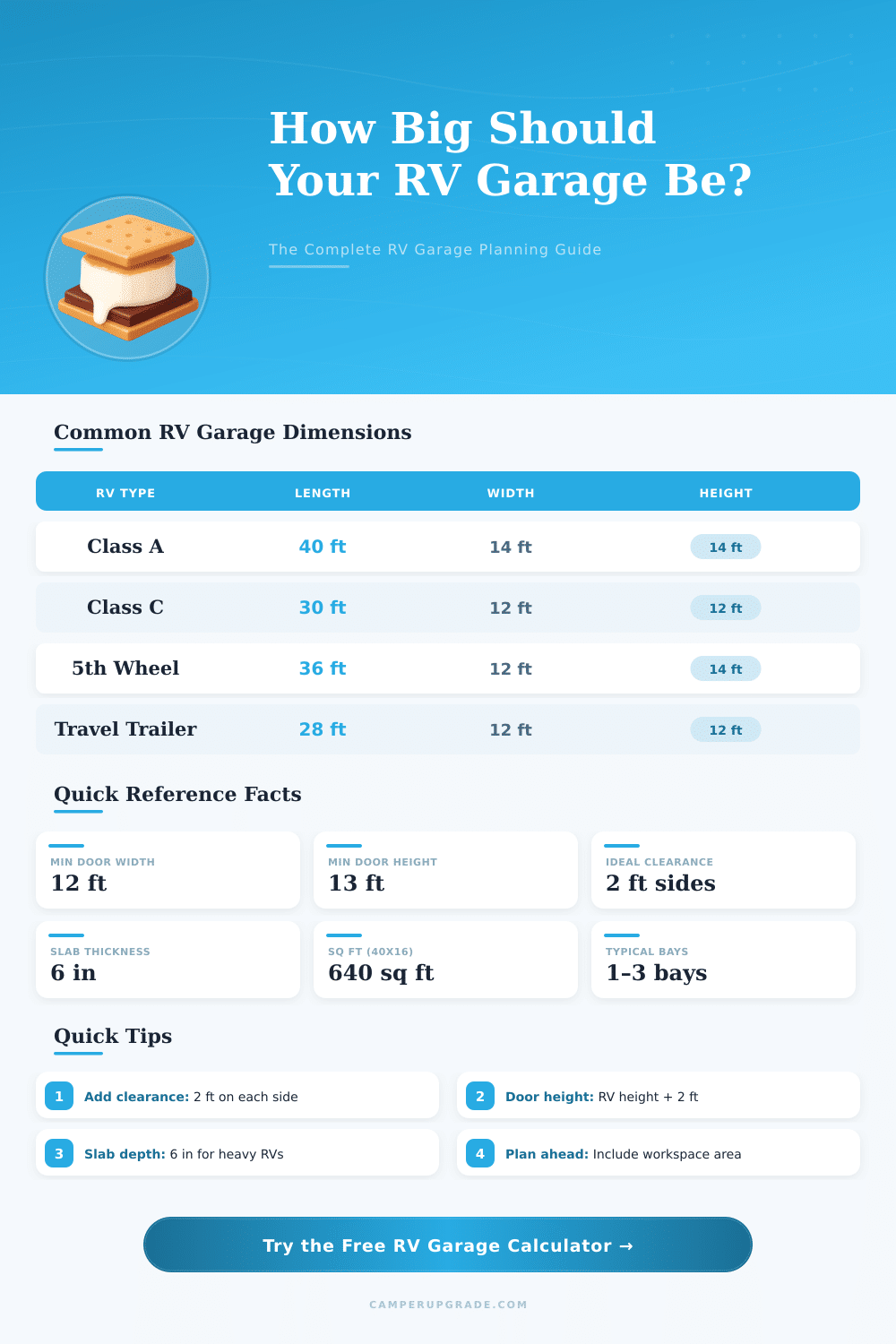
| RV Type | Min Length | Min Width | Min Height | Recommended Floor Area | Door Opening |
|---|---|---|---|---|---|
| Class A Motorhome | 42 ft (12.8 m) | 14 ft (4.3 m) | 14 ft (4.3 m) | 588 sq ft | 14x14 ft |
| Class B Van Camper | 22 ft (6.7 m) | 10 ft (3.0 m) | 9 ft (2.7 m) | 220 sq ft | 10x10 ft |
| Class C Motorhome | 32 ft (9.8 m) | 12 ft (3.7 m) | 12 ft (3.7 m) | 384 sq ft | 12x13 ft |
| 5th Wheel Trailer | 38 ft (11.6 m) | 12 ft (3.7 m) | 14 ft (4.3 m) | 456 sq ft | 12x14 ft |
| Travel Trailer | 30 ft (9.1 m) | 12 ft (3.7 m) | 12 ft (3.7 m) | 360 sq ft | 12x12 ft |
| Pop-Up Camper | 20 ft (6.1 m) | 10 ft (3.0 m) | 8 ft (2.4 m) | 200 sq ft | 10x9 ft |
| Toy Hauler | 44 ft (13.4 m) | 14 ft (4.3 m) | 14 ft (4.3 m) | 616 sq ft | 14x14 ft |
| Teardrop Trailer | 14 ft (4.3 m) | 8 ft (2.4 m) | 8 ft (2.4 m) | 112 sq ft | 8x9 ft |
| Slab Thickness | Cu Yd per 100 sq ft | Cu Yd per 500 sq ft | Cu Yd per 1000 sq ft | Metric (m³ per 100 m²) |
|---|---|---|---|---|
| 4 in (10 cm) | 1.23 cu yd | 6.17 cu yd | 12.35 cu yd | 0.10 m³ |
| 5 in (13 cm) | 1.54 cu yd | 7.72 cu yd | 15.43 cu yd | 0.13 m³ |
| 6 in (15 cm) | 1.85 cu yd | 9.26 cu yd | 18.52 cu yd | 0.15 m³ |
| 8 in (20 cm) | 2.47 cu yd | 12.35 cu yd | 24.69 cu yd | 0.20 m³ |
| 10 in (25 cm) | 3.09 cu yd | 15.43 cu yd | 30.86 cu yd | 0.25 m³ |
| Door Width | Door Height | RV Clearance | Suitable For | Metric Size |
|---|---|---|---|---|
| 10 ft | 10 ft | Class B, Pop-Up | Small campers | 3.0 x 3.0 m |
| 12 ft | 12 ft | Class C, Travel Trailer | Mid-size RVs | 3.7 x 3.7 m |
| 12 ft | 14 ft | 5th Wheel, Class A | Tall RVs | 3.7 x 4.3 m |
| 14 ft | 14 ft | Class A, Toy Hauler | Large motorhomes | 4.3 x 4.3 m |
| 16 ft | 14 ft | Double-wide entry | Multiple vehicles | 4.9 x 4.3 m |
| 18 ft | 16 ft | Commercial RV | Resort / commercial | 5.5 x 4.9 m |
| Project Type | Dimensions | Floor Area | Volume (6 in slab) | Concrete Cu Yd |
|---|---|---|---|---|
| Single RV Bay | 14x40 ft | 560 sq ft (52 m²) | 280 cu ft | 10.4 cu yd |
| Double RV Bay | 28x40 ft | 1,120 sq ft (104 m²) | 560 cu ft | 20.7 cu yd |
| RV + Work Shop | 30x50 ft | 1,500 sq ft (139 m²) | 750 cu ft | 27.8 cu yd |
| Class A Full Size | 16x45 ft | 720 sq ft (67 m²) | 360 cu ft | 13.3 cu yd |
| 5th Wheel Bay | 14x38 ft | 532 sq ft (49 m²) | 266 cu ft | 9.9 cu yd |
| Triple Bay Facility | 42x50 ft | 2,100 sq ft (195 m²) | 1050 cu ft | 38.9 cu yd |
RV Garage is simply space that one builds quite a lot big for holding a large vehicle. They intend to protect that precious purchase and preserve it well kept, when it does not move on the road. For all kinds of RVs various options exist for instance classic motor homes, campers, travel trailers and vans.
Some of those garages are made from steel with I-shaped beams and panels of 26-gauge. Some others rely on canvas material and are made in United States, that one likes because of their resistance against severe weather and long life. Steel structures just like pole barns both enjoy popularity.
How to Plan an RV Garage
The form mostly depends on the building and the place. In regions like Arizona, metallic buildings are commonly not allowed, hence one must use stucco cover with flat roof instead.
The size plays a big role. Making the Garage for 45-foot RV is a wise decision. It is better to add 9 feet than lack one.
For instance, one typical pattern carries 50-foot bay for diesel-push motor home together with a Garage for two cars at it. A Garage of 20 x 35 x 12 for RV can include 12 x 12 door, entry for walkers and two windows. Besides that, a setup of 36 x 40 with upper gates works for storing a bass-boat and an all-terrain vehicle beside the RV.
Adding a porch to the structure gives good area for rest and fun. An upper eyebrow above the upper doors brings shade and helps to keep the Garage safer. Wall-mounted door openers work better than those that rise too the ceiling, because one avoids one more chance to bump something when one works on the roof of the travel vehicle.
A powered 12-foot staircase with handrails makes it easy to climb to the roof of the RV and adds safety.
Electrical and plumbing in the Garage matter a lot. 50-amp power for RV is a great idea, together with a way to empty gray and black tanks right here. Water pipes and plumbing links in the bay make life much more simple.
Commonly one starts the wiring by means of 240V 100-amp service.
Some plans tie living space with Garage for RV. That works as a separate guest house or helpful living unit. One main plan shows a pole barn house with space for a classic RV, extra Garage for three cars, big living area with one bedroom and second floor under the roof.
Keeping the RV protected and out of weather allows one to work on it whenever needed. In the Pacific Northwest, fully closed Garage spaces are truly needed because of the climate and pests. Measuring thehighest part of the vehicle in unloaded state is important before building, to ensure that everything passes through the gates.