⚡ RV Air Conditioner Electricity Calculator
Calculate exactly how much electricity your RV AC uses per hour, day, or month — plus generator sizing and solar requirements
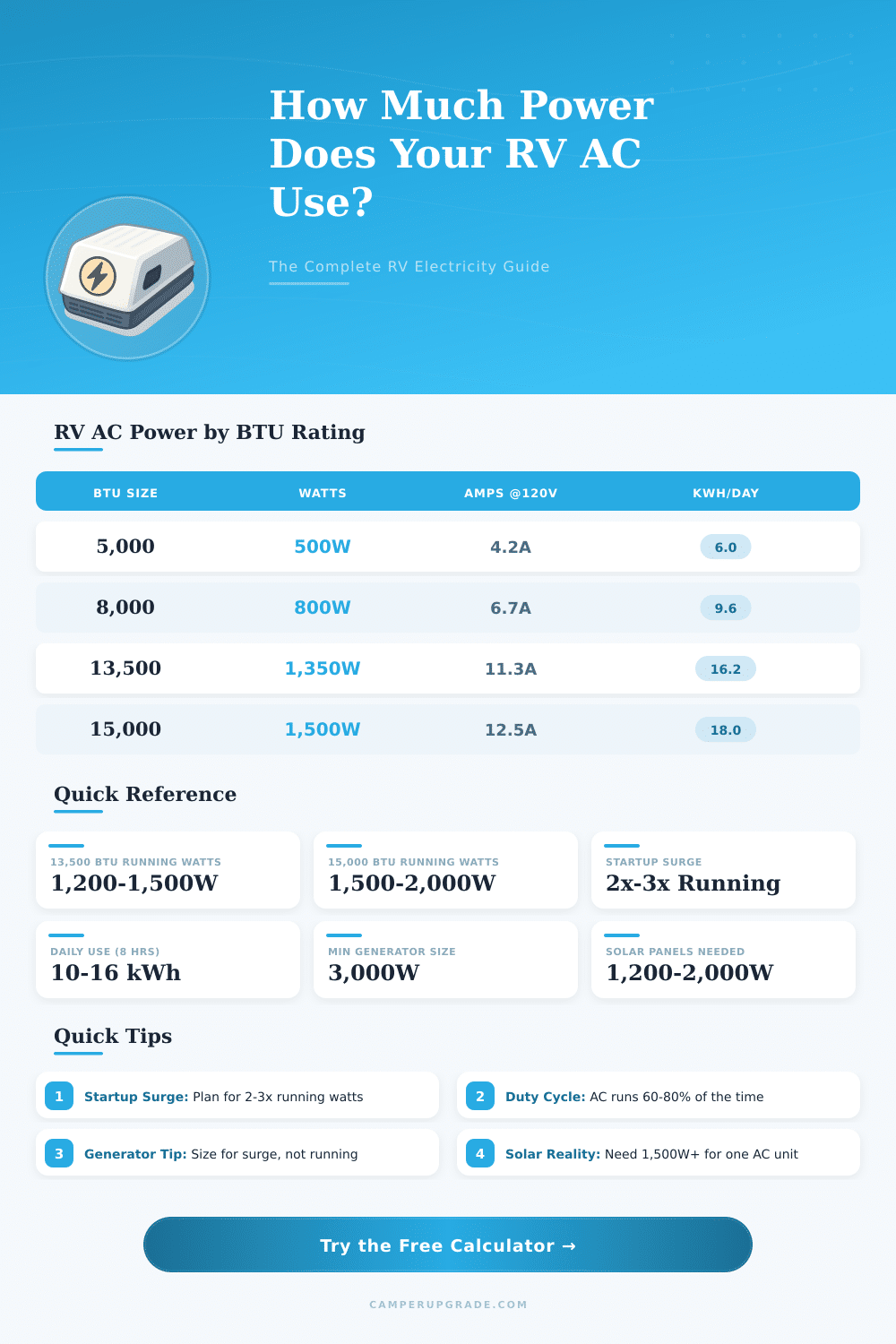
| BTU Rating | Running Watts | Startup Watts | Running Amps @120V | kWh/hr (70% Duty) |
|---|---|---|---|---|
| 5,000 | 450–550 | 1,200–1,500 | 3.8–4.6 | 0.35 |
| 7,000 | 600–750 | 1,500–2,000 | 5.0–6.3 | 0.47 |
| 8,000 | 700–900 | 1,800–2,400 | 5.8–7.5 | 0.56 |
| 9,000 | 800–1,000 | 2,000–2,700 | 6.7–8.3 | 0.63 |
| 11,000 | 950–1,100 | 2,200–3,000 | 7.9–9.2 | 0.72 |
| 13,500 | 1,200–1,500 | 2,800–3,500 | 10.0–12.5 | 0.95 |
| 15,000 | 1,400–1,700 | 3,300–4,500 | 11.7–14.2 | 1.09 |
| 18,000 | 1,700–2,000 | 4,000–5,500 | 14.2–16.7 | 1.30 |
| BTU Rating | 4 Hours | 8 Hours | 12 Hours | 24 Hours |
|---|---|---|---|---|
| 5,000 | 1.4 kWh | 2.8 kWh | 4.2 kWh | 8.4 kWh |
| 8,000 | 2.2 kWh | 4.5 kWh | 6.7 kWh | 13.4 kWh |
| 11,000 | 2.9 kWh | 5.7 kWh | 8.6 kWh | 17.2 kWh |
| 13,500 | 3.8 kWh | 7.6 kWh | 11.3 kWh | 22.7 kWh |
| 15,000 | 4.3 kWh | 8.7 kWh | 13.0 kWh | 26.0 kWh |
| 18,000 | 5.2 kWh | 10.4 kWh | 15.5 kWh | 31.1 kWh |
| AC Setup | Running Watts | Surge Watts | Min Generator Size |
|---|---|---|---|
| Single 13,500 BTU | 1,350W | 3,200W | 3,000W–3,500W |
| Single 15,000 BTU | 1,500W | 3,800W | 3,500W–4,000W |
| Dual 13,500 BTU | 2,700W | 6,400W | 5,500W–7,000W |
| Dual 15,000 BTU | 3,000W | 7,600W | 7,000W–8,000W |
| 13,500 + 15,000 BTU | 2,850W | 7,000W | 6,500W–7,500W |
| Triple 13,500 BTU | 4,050W | 9,600W | 8,000W–10,000W |
| AC Unit | Daily kWh (8 hrs) | Solar Panels Needed | Battery Bank (LiFePO4) |
|---|---|---|---|
| 5,000 BTU | 2.8 kWh | 800W–1,000W | 200Ah @ 12V |
| 8,000 BTU | 4.5 kWh | 1,000W–1,400W | 400Ah @ 12V |
| 13,500 BTU | 7.6 kWh | 1,500W–2,000W | 600Ah @ 12V |
| 15,000 BTU | 8.7 kWh | 1,800W–2,400W | 800Ah @ 12V |
| Dual 13,500 BTU | 15.2 kWh | 3,000W–4,000W | 1,200Ah @ 12V |
RV Air Conditioners are a really good choice for anyone that travels in warm season. The most common models available currently on the market have either a high-profile or low-profile unit that one mounts on the roof. Between popular brands mention Dometic Brisk Air, Coleman Mach 15, Furrion Chill and Advent ACM150.
High-profile units beat the low-profile ones by means of their height and power.
How to Choose an RV Air Conditioner
Furrion Air Conditioners cool quickly and keep stable temperatures in the RV, whether one camps in the strongest summer heat or travels through regions with high temperatures. The Furrion Chill Cube uses vari-speed compressors and was designed as a good energy saving solution for cooling RVs and campers. Hear rumorus about release of models with lower BTU values.
Coleman Mach offers a full series of products for climate control, between that Air Conditioners, heat pumps, ceiling setups, thermostats, converters and extras for RVs, ships and travel trips. Some Coleman rooftop units of 13 500 BTU, installed already in 1994, operate yet quietly today.
RV Air Conditioners mainly work by means of 120-volt shore Electricity, that one connects to a built-in generator or shore power. Like this switched, an Air Conditioner can use a gallon of diesel for every four hours at half power. In the most RVs it is not possible to operate the Air Conditioner by means of batteries, hence the generator must run constantly.
On the other hand, some makers of RVs now install batteries with inverters, that can feed the Air Conditioner. A 12V Air Conditioner works well for cooling only the bedroom during rest, and lithium batteries will suffice to power it.
The newest energy saving models reach more then 40 percent bigger efficiency. They equip themselves with vari-speed engines and do not require soft starting. There is a small model of 8 000 BTU for bedrooms and tiny RVs, together with a unit of 18 000 BTU for bigger areas.
Good insulation is important. An RV with weak insulation hardly stays cool even with a good Air Conditioner. For instance, a 19-foot RV with bad insulation did not manage to keep the cool, while a 26-foot Jayco with same BTU Air Conditioner well managed.
Better to search a ducted Air Conditioner than a simple unit, that blows down in the centre of the main space. RV Air Conditioners usually cool the inside by around 20 degrees. Trying to cool an RV when the inside temperature passes 30 degrees is almost not possible, so one should turn on the Air Conditioner before it gets too warm.
Portable Air Conditioners give freedom and simple setup. But they take much space, commonly are loud and are the most costly kind. Also one must stow them during motion of the RV.
A mini-split system is another option, that runs quietly and delivers cold, dry air with high efficiency.
Before replacing a rooftop unit, it matters to do online research about the particular model of your RV. Videos of anyone that does the setup on same type are useful a lot. A completeset for RV Air Conditioner, with everything needed for the install including rooftop seal and closure, is worth buying.