🏃 Running Trail Distance Calculator
Calculate exactly how much surface material you need for your running trail, path, or track project
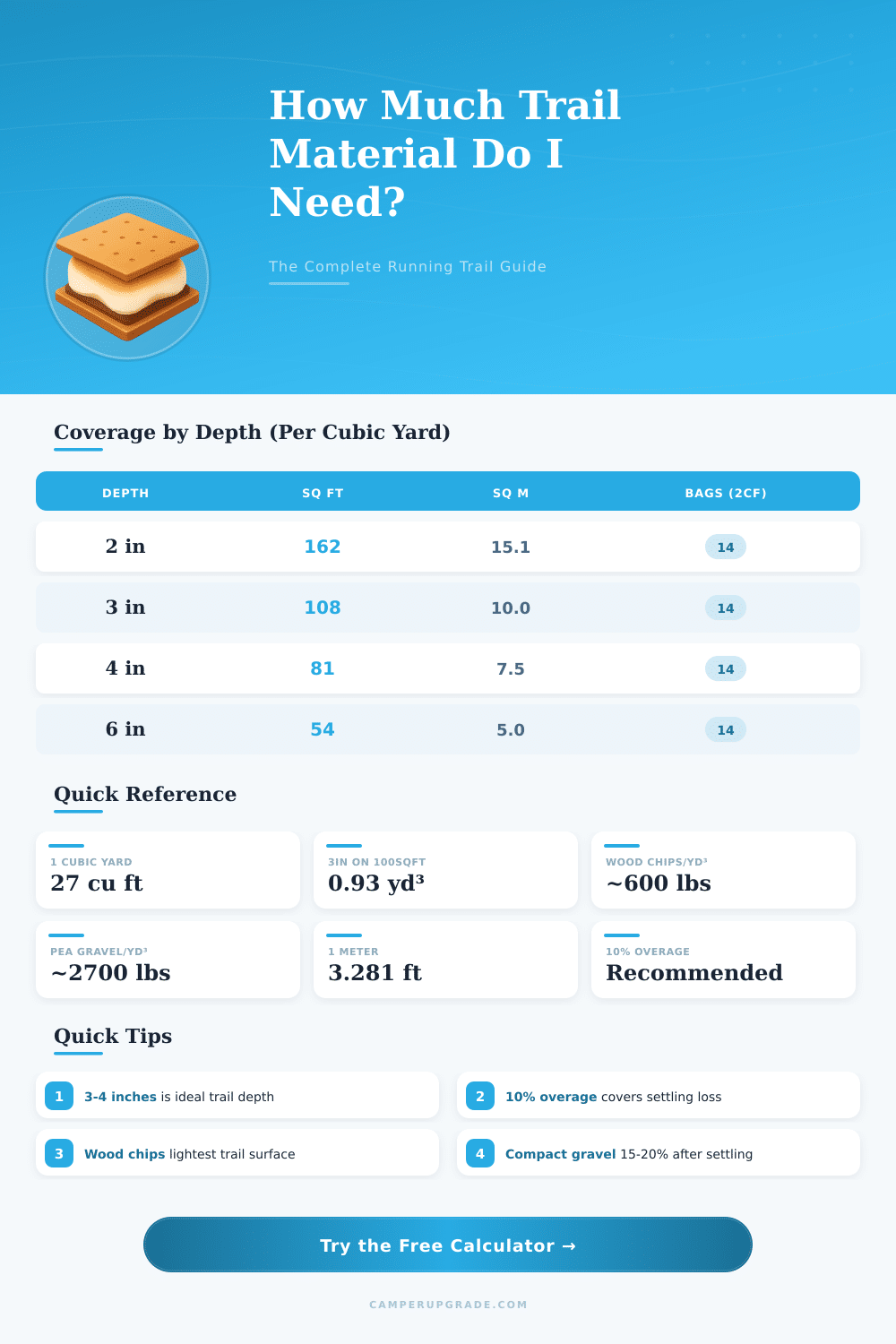
| Depth | Sq Ft Covered | Sq Meters | Trail Length at 4 ft Wide |
|---|---|---|---|
| 1 in (2.5 cm) | 324 | 30.1 | 81 ft (24.7 m) |
| 2 in (5.1 cm) | 162 | 15.1 | 40.5 ft (12.3 m) |
| 3 in (7.6 cm) | 108 | 10.0 | 27 ft (8.2 m) |
| 4 in (10.2 cm) | 81 | 7.5 | 20.3 ft (6.2 m) |
| 6 in (15.2 cm) | 54 | 5.0 | 13.5 ft (4.1 m) |
| Bag Size | Volume per Bag | Bags per Cubic Yard | Coverage at 3 in Depth |
|---|---|---|---|
| 2 cu ft bag | 0.074 yd³ | 13.5 | 8 sq ft (0.74 m²) |
| 3 cu ft bag | 0.111 yd³ | 9 | 12 sq ft (1.11 m²) |
| 0.5 cu ft bag | 0.019 yd³ | 54 | 2 sq ft (0.19 m²) |
| 1 cu ft bag | 0.037 yd³ | 27 | 4 sq ft (0.37 m²) |
| Project | Area (sq ft) | Cubic Yards | 2 cu ft Bags |
|---|---|---|---|
| Short Garden Path (30×3) | 90 | 0.83 | 12 |
| Side Yard Trail (50×4) | 200 | 1.85 | 25 |
| Park Connector (100×4) | 400 | 3.70 | 50 |
| Loop Trail (200×5) | 1,000 | 9.26 | 125 |
| Community Path (400×6) | 2,400 | 22.22 | 300 |
| Nature Trail (1000×4) | 4,000 | 37.04 | 500 |
A single cubic yard of wood chips only covers about 108 square feet at 3 inches deep, and that number floored me the first time I ran it. Bump to 4 inches for a proper running surface and youre down to 81 square feet per yard. Pea gravel weighs around 2600 pounds a yard on average, so even a short 200 by 4 foot path at 3 inches needs roughly 2.5 yards and close to 6,500 pounds of material delivered.
The information below does not come from some computer tool or program. It is based on real experiences of users, talks in forums and shared knowledge through the net.
Trail Running Basics: Shoes, Safety, Training and Food
Trail run is made up of run on open ways under the sky, usually in hilly places. It often has heavy uphill and downhill parts. It is like mountain run and fell-run, that also calls mountain run.
Rather than road run and street run trail run happens mostly on unpaved paths in the middle of nature.
Simple way to imagine it is to see every run on natural soil as trail run. Some describe it even more freely, if the soil moves under your feet, that also counts. There is also city against country viewpoint.
In city living the simplest run is just before the door on sidewalks and streets. Trail run starts, when one leaves the city to search for dirty ground.
Starting with trail run can be fully easy. Simply grab some good shoes and move. Times happen, when it gets difficult and almost painful.
Times are, when it annoys. Even so, the biggset part of the time it simply entertains clearly. Walk the way and already it helps.
Run the way, and that is trail run. But not every way works for run, so it matters to be careful.
Hard run forms a long-term target. If you reach your maximum heart on uphills, simply walk them. Short bursts of ten until fifteen seconds with walking between them help to build stamina on hills.
Safety is important. Falls happen, and some runners fell but came out with only scrapes. Too fast run on rough soil can cause heavy wounds.
During training, follow more the heart than the speed of the run on ways. Pain in unused parts the next day is fully normal. Long weekend trail runs strengthen the legs and build stamina.
Add a bit of speed work on top of that to create firm foundations. One weigh to pass from street to trail is to run trail paths twice weekly and add to easy runs more height than usually.
Trail shoes differ from street shoes. They own more rugged grips so that walking on sharp stones does not hurt. The bottom part has more grip for better hold in mud and on rocky surfaces.
Street shoes weigh less, but they would not work for trail. The range of trail shoes grew much from the middle of the 2000s, when the choices were small compared to today. Back then, one favorite model was the aggressive Speedcross from Salomon.
Today plenty of options exist for every kind of soil, speed, conditions and foot shape. Preferences for brands depend on the place of run. In the Alps, brands like Salomon, La Sportiva and Dynafit are more common for tough terrain, while in areas like Colorado runners choose Saucony, Hoka and Altra for tough soil also.
Ultra marathons got more popular thanks to the attention to runs like UTMB and Leadville. Brands and media cover them more year after year, because records keep breaking. It draws more trail fans to trail races, even if they do not do ultra-distance.
Ultra running means running anything longer than a marathon. Some experts think, that 200-mile runs are too long and too slow, but many trail runners come from hiking background and like the discovery aspect more than the contest.
Nutrition helps during longer runs. For runs more than one hour, around 200 calories each hour form a good starting point, although one must adjust based on body size, duration and soil. For runs more than two and half until three hours, aim for 60 until 90 grams of carbohydrates each hour.
Take around 100 calories from carbs each 20 until 30 minutes during the run to keep the energy. A single pack of gel is a simple fix. Healthy fat also matters in the nutrition for trail run.
Stomach discomfort is acommon complaint among trail runners, because the up and down movements bother the belly.