🏔️ Appalachian Trail Distance Calculator
Calculate hiking distances, elevation gain, pace estimates, and daily mileage between AT landmarks
| State | Miles | Kilometers | % of Trail |
|---|---|---|---|
| Georgia | 78.6 | 126.5 | 3.6% |
| North Carolina / Tennessee | 388.6 | 625.4 | 17.7% |
| Virginia | 550.3 | 885.6 | 25.1% |
| West Virginia | 4.0 | 6.4 | 0.2% |
| Maryland | 40.9 | 65.8 | 1.9% |
| Pennsylvania | 229.3 | 369.1 | 10.4% |
| New Jersey | 72.4 | 116.5 | 3.3% |
| New York | 88.4 | 142.3 | 4.0% |
| Connecticut | 51.6 | 83.0 | 2.4% |
| Massachusetts | 90.2 | 145.2 | 4.1% |
| Vermont | 150.0 | 241.4 | 6.8% |
| New Hampshire | 160.9 | 259.0 | 7.3% |
| Maine | 281.4 | 452.9 | 12.8% |
| Terrain Type | Avg Speed (mph) | Avg Speed (km/h) | Elev. Gain / Mile (ft) |
|---|---|---|---|
| Easy / Flat | 2.5 – 3.0 | 4.0 – 4.8 | 100 – 200 |
| Moderate (avg AT) | 1.5 – 2.0 | 2.4 – 3.2 | 200 – 350 |
| Strenuous | 1.0 – 1.5 | 1.6 – 2.4 | 350 – 500 |
| Extreme (Whites, ME) | 0.7 – 1.2 | 1.1 – 1.9 | 500 – 800+ |
| Hiker Level | Miles / Day | Km / Day | Thru-Hike Duration |
|---|---|---|---|
| Beginner (1st week) | 5 – 8 | 8 – 13 | N/A (section) |
| Average Thru-Hiker | 12 – 16 | 19 – 26 | 5 – 6 months |
| Strong Hiker | 18 – 22 | 29 – 35 | 4 – 5 months |
| Ultra-fast / FKT pace | 30 – 50 | 48 – 80 | 45 – 60 days |
| Section | Distance (mi) | Distance (km) | Typical Days |
|---|---|---|---|
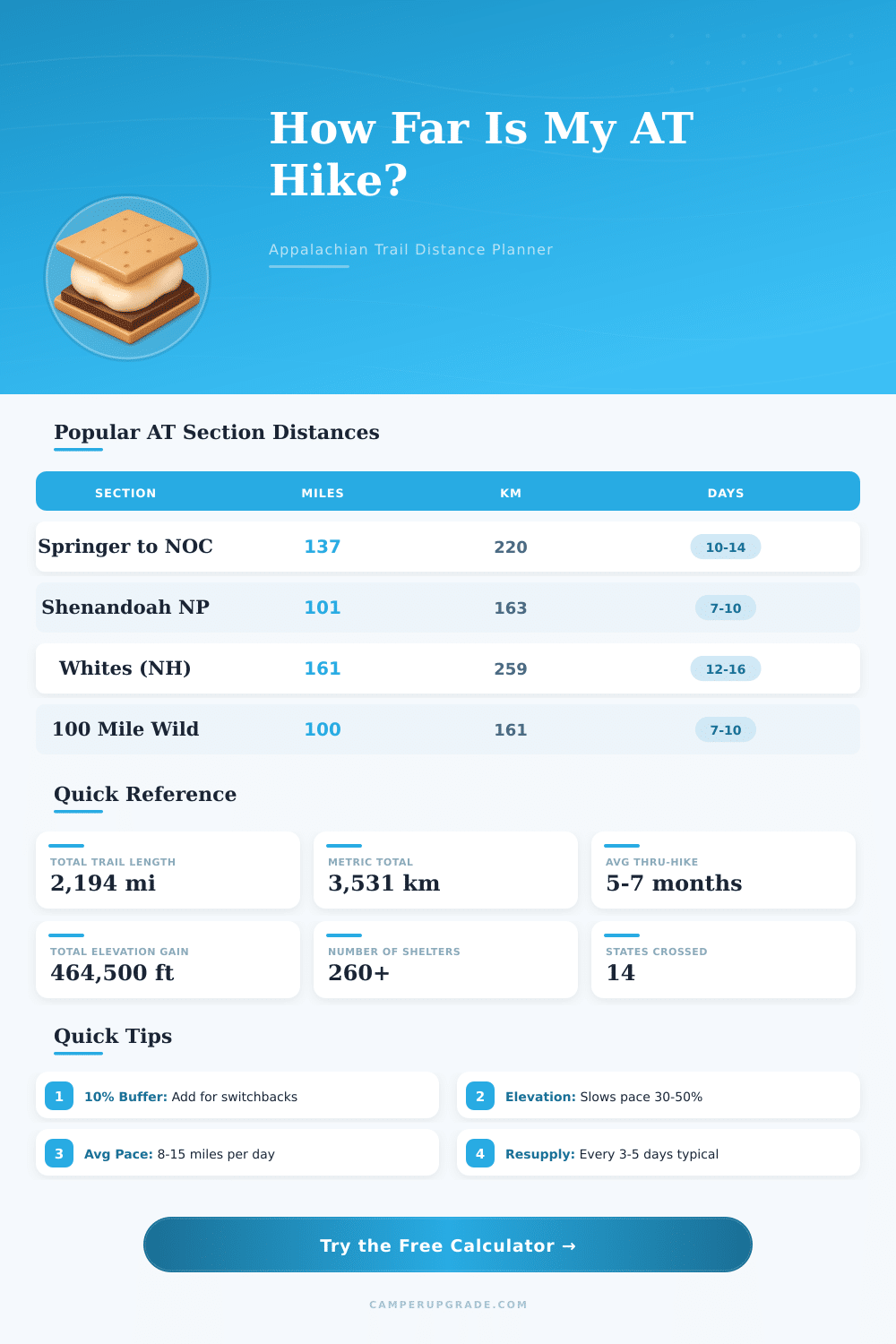
| Springer → Nantahala OC | 137.3 | 221.0 | 10 – 14 |
| Great Smoky Mountains | 71.6 | 115.2 | 5 – 7 |
| Shenandoah National Park | 101.2 | 162.9 | 7 – 10 |
| Harpers Ferry → Duncannon | 76.9 | 123.8 | 5 – 7 |
| NJ Section (Dela. Gap → NY) | 72.4 | 116.5 | 5 – 7 |
| White Mountains | 160.9 | 259.0 | 12 – 16 |
| 100-Mile Wilderness, ME | 100.0 | 160.9 | 7 – 10 |
| Full Thru-Hike | 2,194.3 | 3,531.0 | 150 – 200 |
Add 1 hour for every 2,000 feet (610 m) of elevation gain. On the AT, total cumulative elevation gain is around 464,500 feet (141,570 m) — roughly equivalent to climbing Mt. Everest 16 times. Factor this into your pace calculations for accurate day planning.
Studies show every 10 lbs (4.5 kg) of pack weight reduces your pace by roughly 0.2–0.3 mph on average terrain. An ultralight setup under 15 lbs can add 2–4 extra miles per day compared to a 45 lb traditional pack, which over a 2,194-mile thru-hike translates to 15–30 fewer days on trail.
The full AT runs 2,194.3 miles, or roughly 3,531 km, and Ive found most thru-hikers average somewhere around 12 to 16 miles a day once trail legs kick in. Virginia alone eats up 550 miles, thats 25% of the entire trail in one state. The cumulative elevation gain blew my mind when I first saw it, about 464,500 feet total, which is like summiting Everest 16 times.
Pack weight matters more than people think, every 10 extra pounds shaves about 0.3 mph off your pace. In the Whites I was barely hitting 1 mph on steep sections. A 10% distance buffer for side trails and water access seems right from what Ive tracked.
All About the Appalachian Trail
The information below was not created by some calculator or tool on this page. It comes from actual feedback, forum discussions and experiences of the community found through the internet.
The Appalachian Trail is the longest hiking path with only walking in the world. It goes from Mountain Springer in Georgia to Mountain Katahdin in Maine, and along the way it crosses 14 states. The trail stretches almost 2 200 miles following ridges and crossing big valleys of the Appalachian Mountains.
One also calls it for short the A.T.
The idea about the trail appeared already in 1921. Private people built it, and in 1937 one finished the whole thing. Currently it is among the most known hiking trails of the world.
The Appalachian Trail Conservancy works to protect the trail and the surrounding land.
The trail goes across nice, wooded, grassy, wild and culturally rich landscapes. The more south you go in the south part, the more it becomes difficult. There are many rises between 2 000 and 3 000 feet, with changes of crests and valleys.
In Virginia the trail goes across the National Forests George Washington and Jefferson, from Roanoke county to Pearisburg in Giles county.
The full Distance of the whole trail is a big deal. One needs around four to six months to finish it. One hiker completed the whole 2 189 miles in six months and ten days.
Another finished in five months and four days, using an alternative schedule, that combined three sections, going both north and south. Most full-trail hikers are either in their early twenties, freshly after college, or older then 65 and retiring.
The trail is difficult because of many reasons. The ground is rough and uneven, with roots and rocks. Falling is a real risk, so sturdy shoes or boots are needed.
Snake bites are possible, but they are rare. It also needs much planning and budgeting. Hiking alone mostly is not a very good idea, because wounds can happen when no one is close to help.
Taking a dog can be a good choice, because dogs commonly notice problems before people notice. Geologically, the Appalachian mountains once were linked to the Highlands of Scotland.
There are free shelters along the trail, where one can sleep overnight. Hikers can go even as slow as five miles a day and still make calm progress. There is no need to rush.
Taking breaks and even naps during the day are entirely fine.
Food is a big topic on the trail. Even with around 4 000 calories of daily intake, full-trail hikers still lose around 10 to 20 pounds. Hikers are known for celebrating in towns that the trail crosses.
Common trail snacks include granola with powdered milk, dried salami, cheese, freeze-dried meals, sticks and trail mix. Carefully planning food and water are key to enjoying the experience. Some hikers send food ahead to towns along the trail, while others simply buy what they need and eat in restaurants along the way.
In most places along the south half of the trail hikers can reach a gearshop every week or two to grab forgotten gear. Keeping some no-cook stuff in the bag for dinner is smart for tired evenings. The appetite usually grows after only some days on the trail.
Hikers can go north, south, or do a flip-flop hike. Sectional hiking is also popular. The main point is to go at your own pace andnot care too much about what supposedly is “authentic” full-trail hiking.