🛻 32 Foot Camper Weight Calculator
Estimate dry weight, GVWR, tongue weight & payload for any 32 ft RV type
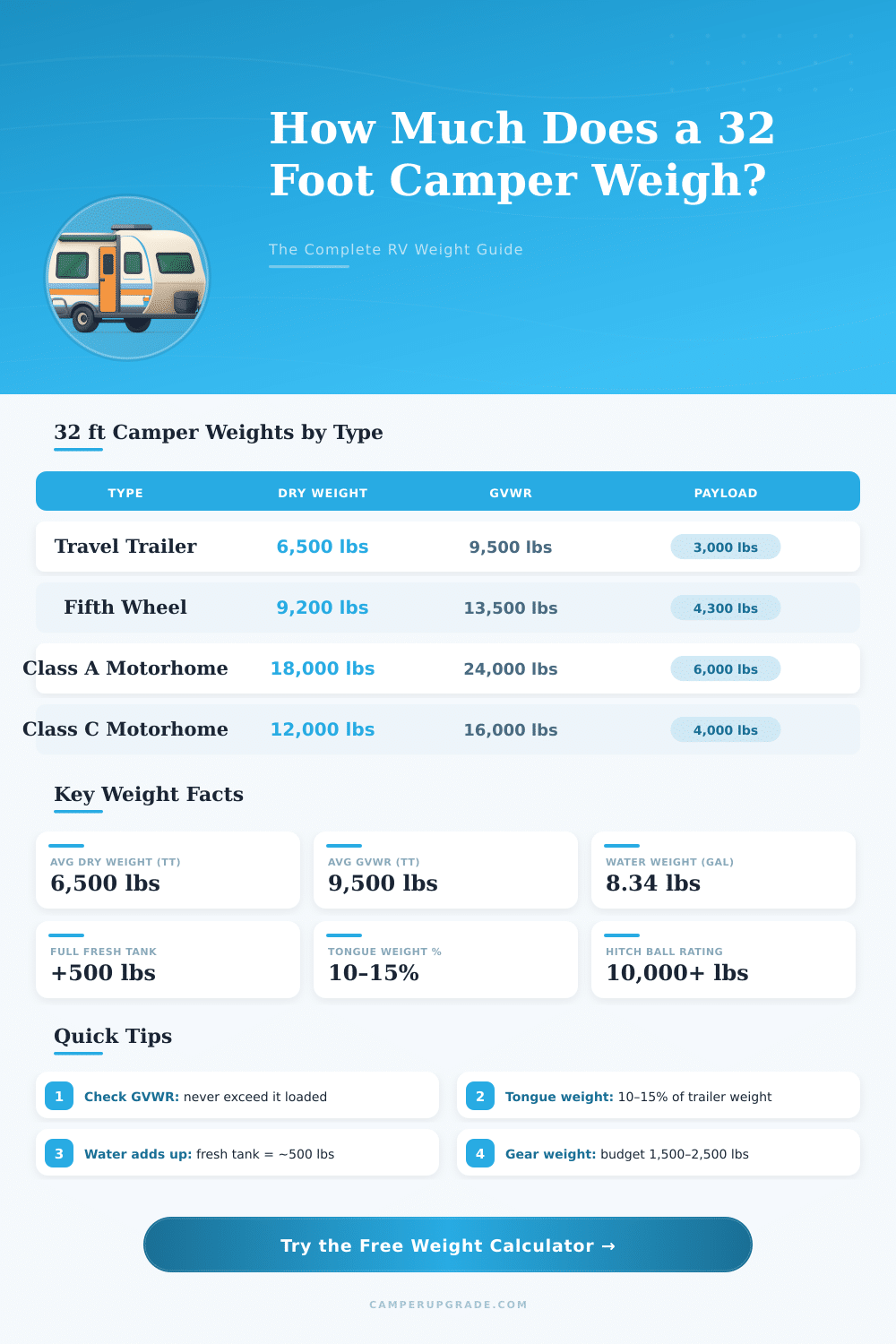
| RV Type | Dry Weight (lbs) | GVWR (lbs) | Max Payload (lbs) | Tongue/Pin Wt (lbs) |
|---|---|---|---|---|
| Travel Trailer (std) | 6,000–7,000 | 9,000–10,000 | 2,500–3,500 | 600–1,000 |
| Travel Trailer (lightweight) | 4,000–5,500 | 6,500–8,000 | 1,500–2,500 | 400–800 |
| Fifth Wheel (std) | 8,500–10,000 | 13,000–15,000 | 3,500–5,000 | 2,000–3,000 |
| Fifth Wheel (luxury) | 10,500–13,000 | 16,000–20,000 | 4,000–6,000 | 2,500–4,000 |
| Class A Motorhome | 16,000–20,000 | 22,000–26,000 | 4,000–7,000 | N/A |
| Class C Motorhome | 10,000–14,000 | 14,000–18,000 | 3,000–5,000 | N/A |
| Toy Hauler (fifth wheel) | 8,000–10,500 | 14,000–18,000 | 4,000–6,000 | 1,800–3,500 |
| Park Model | 9,500–12,000 | 12,000–15,000 | 2,000–4,000 | N/A |
| Item | Weight per Unit | Typical 32 ft Amount | Total Weight |
|---|---|---|---|
| Fresh water (full tank) | 8.34 lbs/gal | ~60 gallons | ~500 lbs |
| Gray water (full tank) | 8.34 lbs/gal | ~40 gallons | ~333 lbs |
| Black water (full tank) | 8.34 lbs/gal | ~30 gallons | ~250 lbs |
| LP propane (20 lb tank) | ~37 lbs filled | 2 tanks | ~74 lbs |
| LP propane (30 lb tank) | ~55 lbs filled | 2 tanks | ~110 lbs |
| Slide-out (per slide) | ~400–800 lbs | 2 slides | ~800–1,600 lbs |
| Clothing & personal gear | varies | light load | ~200–500 lbs |
| Food & kitchen supplies | varies | moderate | ~100–300 lbs |
| Tools & outdoor equipment | varies | typical | ~100–400 lbs |
| Bikes, kayaks, toys | varies | 2 bikes + gear | ~100–600 lbs |
| Total Trailer Weight | Tongue Weight (10%) | Tongue Weight (15%) | Min Hitch Class |
|---|---|---|---|
| 5,000 lbs | 500 lbs | 750 lbs | Class III |
| 7,500 lbs | 750 lbs | 1,125 lbs | Class IV |
| 10,000 lbs | 1,000 lbs | 1,500 lbs | Class IV/V |
| 13,000 lbs | 1,300 lbs | 1,950 lbs | Class V |
| 16,000 lbs | 1,600 lbs | 2,400 lbs | 5th Wheel |
| 20,000 lbs | 2,000 lbs | 3,000 lbs | 5th Wheel (heavy) |
Knowing the weight of a camper is one of the most important tasks that one must figure out before heading on the way. Campers for travel weigh somewhere between around 1 000 and 8 500 pounds. That range depends a lot on the length, the size and various other things.
Pop-up campers tend to be more lightweight, with weights of 600 pounds up to more than a ton. Little models of that type range between 1 500 and 7 000 pounds, depending on the ability of your car.
How Heavy Are Campers and How to Tow Them Safely
Fifth-wheel campers weigh a lot more. On average they have around 12 700 pounds when they are empty and unloaded. Toy-hauler campers are even heavier, with gross vehicle weight ratings of almost 15 000 up to more than 22 000 pounds.
Some RVs weigh between 10 000 and 13 000 pounds, depending on their length and internal layout. Models with slide-out sections and living rooms reach 15 000 pounds. And the biggest motorhomes?
They stretch up to 45 feet long and pass 50 000 pounds in weight.
Here is the spot where everything gets tricky. The dry weight means the weight of the camper without goods, fuel or passengers. It changes according to the used materials, the build, the furniture inside and the whole size.
More comfrotable extras commonly add weight. Even so dry weight does not show what you really will drag. One must add around 1 500 pounds for gear and water to that value.
A practical rule is to add only 1 000 pounds to the dry weight to reach something closer to reality.
The tongue weight also matters. It relates to the part of the camper weight that loads the hitch. It should sit between 10 and 15 percent of the whole camper weight.
Campers with one axle commonly have higher tongue weight. The specs of the maker can point to one value, but in the real world the numbers commonly differ a lot.
Finding a camper under 1 000 pounds is a challenge. There are some teardrop campers that have mainly a cabin with a bed, some cabinets and a kitchen area. For those that want too stay lightweight, look for models with dry weight under 1 050 to 1 100 pounds; that gives space for gear and water without passing 1 200 pounds loaded.
Check the limits of your car for pulling, looking at the sticker on the driver door frame. It normally lists the gross vehicle weight rating, the gross axle weight and the curb weight. The curb weight is the weight of the empty car with standard gear, liquid and full tank for fuel.
Gross trailer weight ratings appear in the owner manual, online in specs or marked directly on the trailer itself. That value is set by the factory as the biggest tow weight, and one never should pass it.
Dragging at the maximum ability of your car is not a good idea. It adds serious stress to the transmission. Staying a bitunder the limit helps to keep everything safer and run more smoothly.