🔥 Small Coleman Propane Tank Runtime Calculator
Find out exactly how long your 1 lb (16.4 oz) Coleman propane tank will last for any appliance
1 Burner (BTU/hr)
2 Burner (BTU/hr)
High Setting (BTU/hr)
(BTU/hr)
(BTU/hr)
(BTU/hr)
Total BTU Capacity
Total BTU Capacity
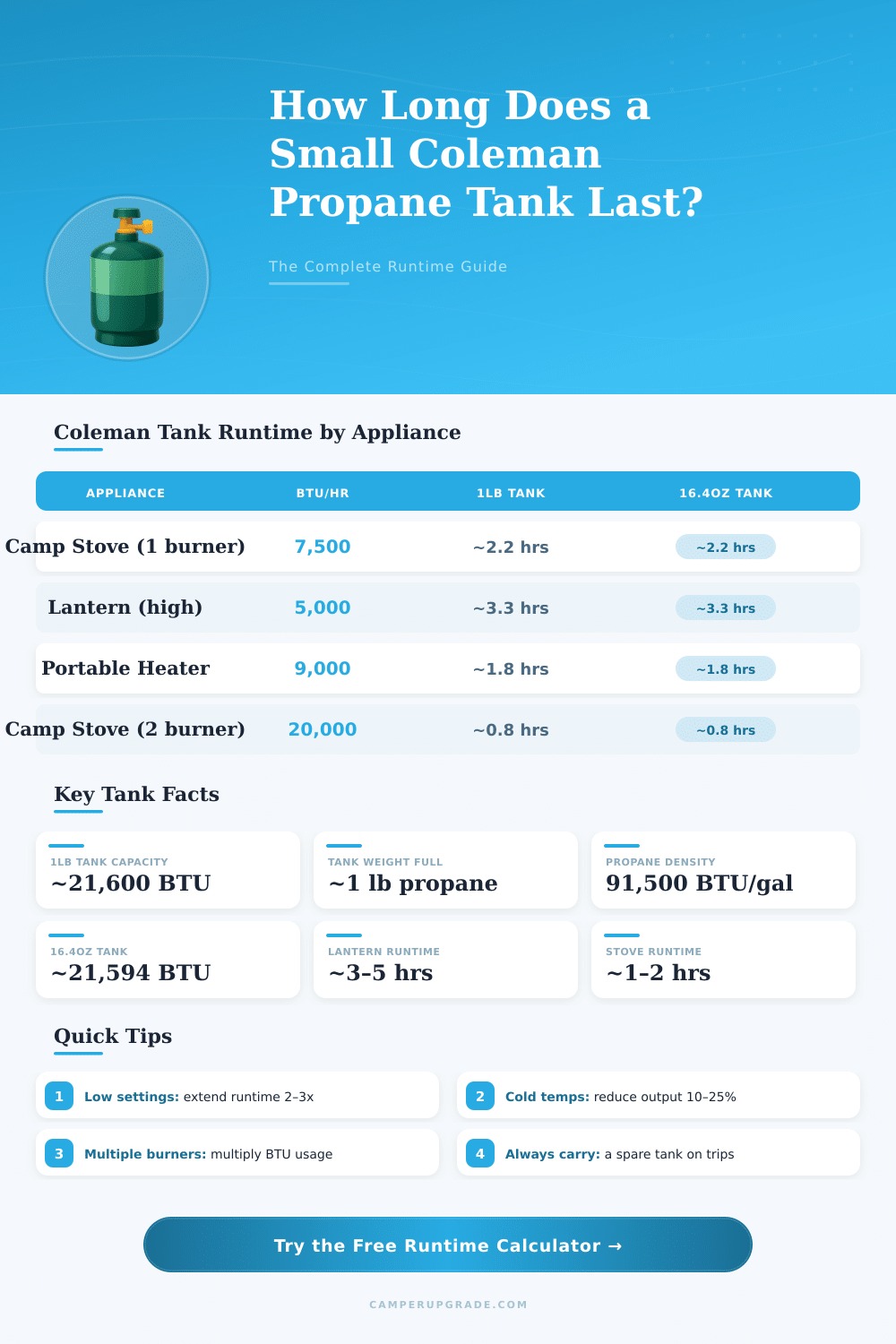
| Appliance | BTU/hr (High) | Runtime High | Runtime Medium | Runtime Low |
|---|---|---|---|---|
| Camp Stove (1 Burner) | 7,500 | ~2.9 hrs | ~4.1 hrs | ~7.2 hrs |
| Camp Stove (2 Burner) | 20,000 | ~1.1 hrs | ~1.5 hrs | ~2.7 hrs |
| Lantern (High) | 5,000 | ~4.3 hrs | ~6.2 hrs | ~10.8 hrs |
| Lantern (Low) | 2,500 | ~8.6 hrs | — | — |
| Portable Heater | 9,000 | ~2.4 hrs | ~3.4 hrs | ~6.0 hrs |
| Tabletop Grill | 15,000 | ~1.4 hrs | ~2.1 hrs | ~3.6 hrs |
| Camp Coffee Maker | 3,200 | ~6.7 hrs | ~9.6 hrs | — |
| Fire Starter | 1,000 | ~21.6 hrs | — | — |
| Tank Size | Weight (oz) | BTU Capacity | kJ Capacity | Propane (lbs) |
|---|---|---|---|---|
| Small Canister (8 oz) | 8 oz / 227 g | ~10,540 BTU | ~11,120 kJ | 0.5 lb |
| Standard 1 lb (16.4 oz) | 16.4 oz / 465 g | ~21,594 BTU | ~22,780 kJ | 1.0 lb |
| Large Canister (16 oz) | 16 oz / 454 g | ~21,080 BTU | ~22,238 kJ | ~0.98 lb |
| 5 lb Cylinder | 80 oz / 2,268 g | ~107,970 BTU | ~113,908 kJ | 5.0 lb |
| Measurement | Imperial | Metric | Notes |
|---|---|---|---|
| 1 lb propane | 21,594 BTU | 22,780 kJ | Standard energy content |
| 1 gallon propane | 91,502 BTU | 96,523 kJ | Liquid propane |
| 1 oz propane | ~1,350 BTU | ~1,424 kJ | Approx. per ounce |
| 1 kg propane | ~47,483 BTU | ~50,070 kJ | Metric equivalent |
| 1 BTU | 1 BTU | 1.0551 kJ | Exact conversion |
Know about various kinds of propane tank and their basic uses really helps a lot. For RVs, the most common sizes of propane tank are 20-pound and 30-pound. In campers one usually uses portable propane tanks that one calls 20-pound tanks.
Some RVs, especially the smaller ones like travel trailers, truck campers and fifth wheels carry one or two such propane tanks. One finds horizontal tanks, that are mounted fixed, on Class A motorhome RVs, and them one must fill directly on the vehicle at a station for propane refilling. Vertical and removable tanks work best for towable units, for instance travel trailers and fifth wheels.
Propane Tanks for RVs: Sizes, Uses and Safety
One fills tanks only until 80% of the capacity, never fully, to avoid explosive risk because of gas expansion. It is smart to choose the biggset tank possible, to fully use the propane as energy source. Propane itself does not go bad over time, but the tank can wear out.
So it matters to check the expiry date, because some stations refuse to fill expired tanks.
Many motorhome RVs and some fancy trailers have built-in monitor panels, that show the level of propane in tanks by means of marks like full, two-third, one-third and empty. There is also a system called OneControl, that works by means of magnetic sensing in the bottom of a vertical propane steel tank. It connects to an app and allows to check the propane from up too 40 feet away.
A 20-pound tank can last for a whole season of camping, especially when one combines it with propane and electric water heaters. During cool weather, a 30-pound tank for heat and cooking in a small fifth wheel lasts from 7 days in very cold conditions until around 17 days, if the temperatures are a bit mild. A five-gallon tank lasts about two until three weeks, depending on the weather and the number of working devices.
Propane tanks one can buy at places like hardware stores, RV stores and big gas stations. You do not need to buy them at an RV dealer. Some propane stores even offer rental of big tanks with monthly billing.
Filling a reusable tank can seem harder than simply swapping a disposable one, and full tanks often weigh more than one expected. Tractor Supply does not accept filling, if one brings a tank lying down, so one must transport it standing up.
For safety, propane heaters and water heaters always must ventout. Safe transport of propane in a car requires a special box, that stops any leaking gas from entering the cabin. Propane accidents with campers happen very rarely, yet one should check fire safety devices and know how to use the emergency exits.