🎒 Backpacking Weight & Size Calculator
Calculate your total pack weight, base weight category, and recommended backpack size
| Total Pack Weight | Trip Length | Pack Size (Liters) | Pack Size (Cubic In) |
|---|---|---|---|
| 10–15 lbs (4.5–6.8 kg) | 1–2 days | 25–35 L | 1,525–2,135 in³ |
| 15–25 lbs (6.8–11.3 kg) | 2–3 days | 35–50 L | 2,135–3,050 in³ |
| 25–35 lbs (11.3–15.9 kg) | 3–5 days | 50–65 L | 3,050–3,966 in³ |
| 35–45 lbs (15.9–20.4 kg) | 5–7 days | 65–80 L | 3,966–4,882 in³ |
| 45+ lbs (20.4+ kg) | 7+ days / winter | 80–100+ L | 4,882–6,100+ in³ |
| Gear Item | Ultralight | Lightweight | Traditional |
|---|---|---|---|
| Shelter (tent/tarp) | 1.0–1.5 lbs (0.5–0.7 kg) | 2.0–3.5 lbs (0.9–1.6 kg) | 4.0–6.0 lbs (1.8–2.7 kg) |
| Sleep System (bag + pad) | 1.5–2.5 lbs (0.7–1.1 kg) | 3.0–4.5 lbs (1.4–2.0 kg) | 5.0–7.0 lbs (2.3–3.2 kg) |
| Backpack (empty) | 1.0–2.0 lbs (0.5–0.9 kg) | 2.5–4.0 lbs (1.1–1.8 kg) | 4.5–6.5 lbs (2.0–2.9 kg) |
| Big Three Total | 3.5–6.0 lbs (1.6–2.7 kg) | 7.5–12.0 lbs (3.4–5.4 kg) | 13.5–19.5 lbs (6.1–8.8 kg) |
| Item | Weight Per Unit | Daily Need | 5-Day Total |
|---|---|---|---|
| Water | 2.20 lbs/L (1.0 kg/L) | 2–4 L carried | Resupply daily |
| Food (freeze-dried) | 125 cal/oz avg | 1.25–1.5 lbs/day | 6.25–7.5 lbs |
| Food (standard mix) | 100 cal/oz avg | 1.75–2.0 lbs/day | 8.75–10.0 lbs |
| Food (heavy / fresh) | 70–90 cal/oz | 2.0–2.5 lbs/day | 10.0–12.5 lbs |
| Fuel (canister) | 7.8 oz full canister | ~0.7 oz/day (1 person) | 3.5 oz (1 canister) |
| Trip Type | Base Weight | Consumables | Total Carry |
|---|---|---|---|
| Day Hike | 3–6 lbs (1.4–2.7 kg) | 3–5 lbs (1.4–2.3 kg) | 6–11 lbs (2.7–5.0 kg) |
| UL Weekend | 7–10 lbs (3.2–4.5 kg) | 5–8 lbs (2.3–3.6 kg) | 12–18 lbs (5.4–8.2 kg) |
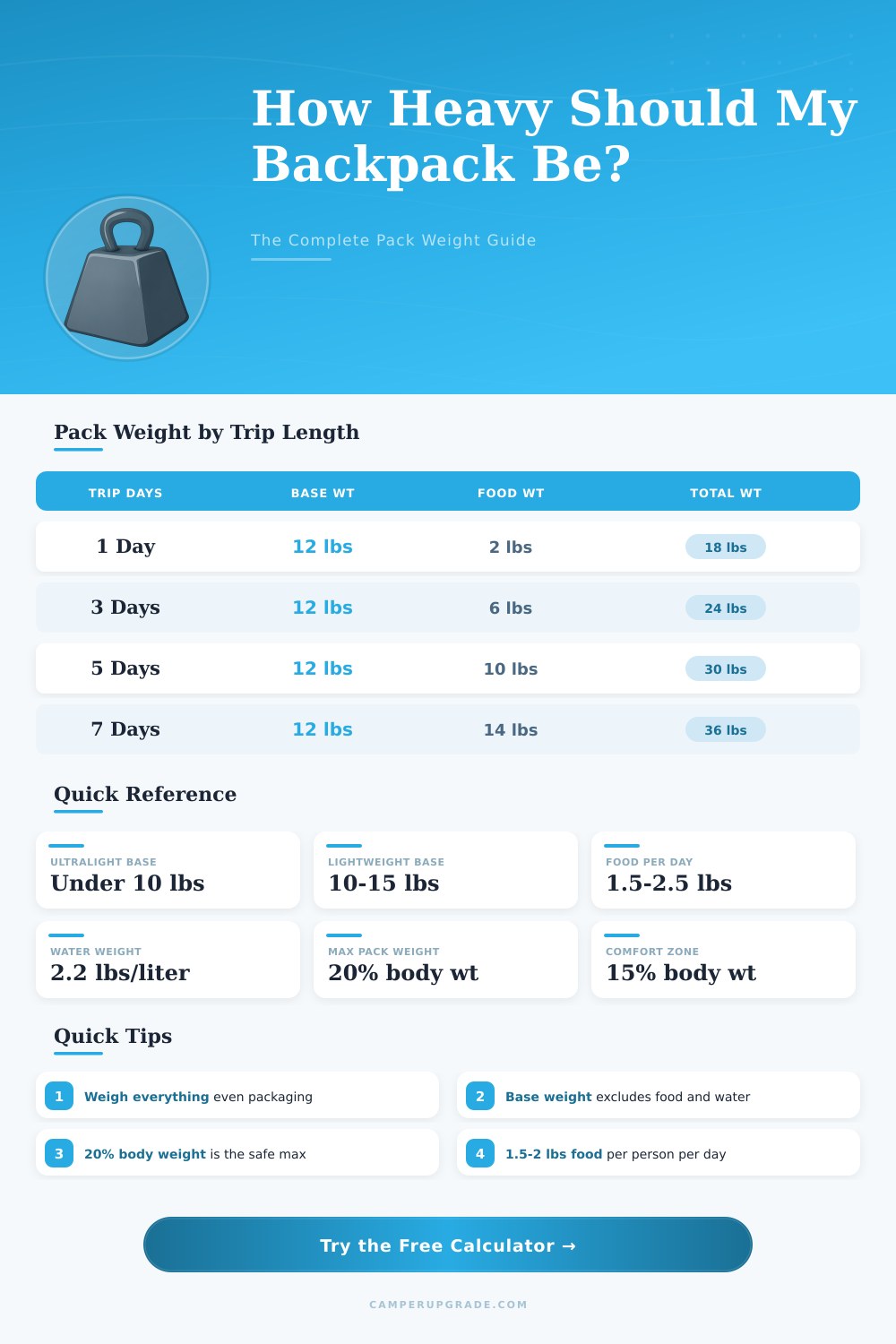
| 3-Day Standard | 12–16 lbs (5.4–7.3 kg) | 8–12 lbs (3.6–5.4 kg) | 20–28 lbs (9.1–12.7 kg) |
| 5-Day Trek | 12–18 lbs (5.4–8.2 kg) | 12–18 lbs (5.4–8.2 kg) | 24–36 lbs (10.9–16.3 kg) |
| Winter 3-Day | 18–25 lbs (8.2–11.3 kg) | 10–14 lbs (4.5–6.4 kg) | 28–39 lbs (12.7–17.7 kg) |
| 7-Day Resupply | 12–18 lbs (5.4–8.2 kg) | 16–22 lbs (7.3–10.0 kg) | 28–40 lbs (12.7–18.1 kg) |
A 170 lb hiker carrying 34 lbs hits that 20% body weight threshold — honestly thats where my knees start complaining. Drop to 15% and youre at 25.5 lbs, which feels dramatically different over 10 miles. Water alone at 2 liters adds 4.4 lbs, and food runs about 2 lbs per day for most 3-season trips.
The weight of backpacking weight,size form a tender balance, that can make or destroy a whole trip. It is made up of the base load, that you will carry during the whole way, except items like food and drinks. You can choose the classic backpack, that weighs around 9 kilos base weight or more, or the ultralight option, that aims under 5 kilos.
How Much Should Your Backpack Weigh
Every method has its pros but everything depends on your actual trip and the way you want to live it.
New backpacks commonly reach 9-14 kilos total, what is entirely doable for weekend hikes or short overnights. However the fans of ultralight work on another level, always improving and simplifying until that magic base under 5 kilos. Some of them go to extremes, cutting toothbrushes and utensils and watching every extra weight.
Actually, getting your base weight under 9 kilos turns out quite a lot eaisly by means of some wise choices of gear.
Naturally, the ideal total weight is affected by many things, season, landscape and your main plans for the trip. During summer, my base sits around 6 kilos. When season-specific causes add up, it grows to 7-8 kilos.
For full winter gear I usually aim around 12 kilos, not counting water. There is a lot of room hear, but the secret sits in fitting your gear to the exact needs of the journey.
An old thumb-rule suggests, that your weight should not pass 20 percent of your body mass. So for folk of 70 kilos that gives a 14 kilo limit for backpacking weight,size and 7 kilos for day hikes. But better aim for 10-15 percent, to protect your joints and stay comfortable.
Back in the 1970s people believed, that you can carry a third of your weight. Well, we moved past that!
Ideally, your lightweight backpack should weigh between 5 and 9 kilos, including itself. Everything above 9 kilos, especially in winter, can quickly tire you out. The difference between 7 and 9 kilos does not seem big, but that extra mass adds up over long distances.
It is good to test your full weight during a day hike, to feel how your body handles it.
And do not forget about food… It forms a big part of your whole weight. Aim for 0.7-1.1 kilos per person per day, based on your body size and activity.
0.9 kilos per day is a good starting point for a three-season trip. Some hikers like to stay near 0.7 kilos. On longer trails food can easily become the main heavy item.
Close planning of meals helps to avoid overloading withunnecessary treats.
On long hikes like the Pacific Crest Trail, they advise a max total of 9-11 kilos, to finish the whole thing in one season without injury. It all deals with finding the right balance between comfort and the real demands of the journey. Small changes to your gear and food can make a whole world of difference.